

On the night of July 15th, 1980, a crowd gathered at the Bangor Civic Center to watch something Maine hadn’t seen in 45 years. The state was about to pick who got to hunt a moose.
The drawing was on live TV, protesters carried picket signs, and one arrived in a moose suit made of papier-mâché, burlap and brown flannel.
How did Maine get here? The story starts with the moose almost disappearing.
Why did Maine stop hunting moose?
By the early 1900s, Maine’s moose were in trouble. Unrestricted hunting, including market hunting, and the clearing of forests for farmland had cut the herd to a few thousand animals, according to the Bangor Daily News.
The state tightened the rules again and again. The last season came in 1935, and by then it was small. A 1980 Bangor Daily News story says it was open only in Knox, Waldo and Lincoln counties, where about 1,191 hunters took 37 bulls.
Then the state closed it entirely. For the next 45 years, shooting a moose in Maine was against the law.
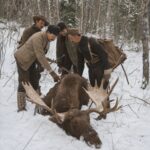
That’s a long way from the old days, when a dead bull moose was a trophy worth a photograph. Check out this stereoview card from 1899. The title says it all.

The moose came back
During the closure, the herd grew. By 1980, wildlife scientists put Maine’s moose population at about 20,000. And since 1979, the moose had been Maine’s official state animal.
By the late 1970s, hunters wanted a season again. Plenty of Mainers did not.

A wake for the moose at the State House
On Friday, March 23rd, 1979, the Maine Senate voted to bring the moose hunt back. The opponents didn’t go quietly.
Sen. Gerard P. Conley of Portland held what he called a “wake” for the moose in his State House office. A plastic moose lay in a coffin on his desk. Guests got chocolate “moose drops” and a green dessert called “Irish moose.”
Here’s how the Associated Press described the scene in the Senate:
“With one lamenting lawmaker playing taps on a slide trombone in the background, the Maine Senate declared open season Friday on the majestic moose, the big slow-witted beast that graces the state seal.”

The trombone belonged to Rep. Stephen R. Gould of Stillwater. Conley wore a black armband with a white “M” and handed out a “death certificate” for the moose. It read: “The moose is unarmed and has no lobbyists.”
Sen. Walter W. Hichens of Eliot even tried an original poem. He also had this to say:
“March 23, 1979, will go down in history,” he said, “as the day the grand and stately moose lost its privilege to run free.”
The bill passed anyway, and Gov. Joseph E. Brennan indicated he would allow the hunt. (The AP couldn’t resist noting that Brennan’s car had once hit a moose.)
The first moose lottery
The law set up a six-day “experimental” season, September 22nd to 27th, 1980. To keep it fair, hunters would be picked by lottery. You paid $5 to enter, and the drawing was for Maine residents only.
The Senate bill had called for 500 hunters. By the drawing, it was 700 permits, and the Bangor Daily News reported that 32,269 people had paid the $5.
The state held the drawing at the Bangor Civic Center on Tuesday, July 15th, 1980, and the Maine Public Broadcasting Network carried it live. Officials set up about 1,000 chairs and brought in police, expecting a full house of hunters and protesters.
Only about 100 people came, including media personnel, police and guests on the telecast. The organizers figured most applicants had watched from home.

The first name drawn was Gary Cain of Caribou, a 24-year-old radio salesman. He was watching the telecast at home and said he was in a state of disbelief. He’d figured he would be lucky just to hear a name he knew.
The protesters were there too. One carried a sign that read “Smooch A Moose Goodbye.” That was Leah Girardin of Waterville, in the moose suit she designed herself, with burlap-and-wire antlers and a “No Hunting” sign around her neck.

Commissioner Glenn Manuel told them the hunt would give biologists moose to study. One man in the audience had his own take. “It was worth it to come down here just to see these nuts,” he told a friend.
The winners still had to pay up. A hunting license was $9.50, the moose permit $10, and another $10 to tag a moose. All in, that was $34.50.
Opening day in Greenville
The season opened at 5:56 a.m. on Monday, September 22nd, 1980, a half-hour before sunrise. By that night, hunters were lined up at the tagging station in Greenville.

By Monday night, the Greenville headquarters had registered 83 moose, and another 30 or so came in at five other tagging stations. Warden Major Russell Dyer said the biggest one weighed more than half a ton.
The wardens even ran a pool on how many moose would be killed by Saturday. Dyer guessed 333. I love that.
And back in Augusta? An anonymous moose lover hung black crepe paper over the glass case in the State House that holds two stuffed moose. Somebody took it down later that day.
By the end of the week, the Bangor Daily News reports, 91 percent of the hunters had filled their tags.
SMOOSA and the 1983 vote
Think that settled it? There was no hunt in 1981, and when it came back in 1982, opponents organized.
Their leader was John Cole, a founding editor of the weekly Maine Times. His group had a very Maine name: SMOOSA, for Save Maine’s Only Official State Animal. It gathered enough signatures to put the question to voters.
On Tuesday, November 8th, 1983, Mainers voted on whether to repeal the moose hunt. The Bangor Daily News front page the next morning put the question in a box shaped like a set of antlers.

The campaign divided Maine’s conservation groups as well as hunters. The Bangor Daily News reported that Maine Audubon took no position, while the Natural Resources Council of Maine supported the hunt as a game-management tool.
When all the votes were in, the hunt stayed. The repeal lost about 60.5 percent to 39.5 percent.
Moose weren’t Maine’s only wildlife to come under legal protection. Out on Matinicus Rock, lighthouse keepers protected nesting seabirds, including puffins that had nearly disappeared from the state.
The moose lottery today
More than four decades later, the lottery is a Maine tradition. Each June the state draws the names, and people who have applied for years still hope this is their year.
The 2026 drawing was held on June 20th at the Acton Fairgrounds, and the state issued 3,705 permits through the lottery. That’s more than five times the 700 tags of 1980.

As for the Bangor Civic Center, where Gary Cain’s name came out of the drum first? It was torn down in 2013, along with the Bangor Auditorium. Their replacement, the Cross Insurance Center, opened next door that fall.
Liked this one? Get more tomorrow.
Lost Maine stories in your inbox most mornings: the newest, plus a few from the archive.
 This storyMaine’s Moose Lottery: The Moose Wake, the Moose Suit and the First Hunt in 45 Years
 The Witch’s Curse of Bucksport: The Leg on Jonathan Buck’s Tomb
 The Night Camden Burned: How the Great Fire of 1892 Built Today’s Brick Downtown
Free. Unsubscribe anytime.
AI assisted editing and source review. The featured image is a single view cropped, restored and colorized with AI from an 1899 stereograph. Colors and restored fine details are interpretive. The full original stereograph is retained later in the article. Here’s how we use AI.Suggest a correction