

George Spratt said a picture of wolves cost him hundreds of dollars. For a man trying to persuade people onto his stagecoach line between Bangor and Calais, it was an expensive piece of artwork.
His competitors had plenty to say about that trip through the woods. In Spratt’s account, they used stories of wolves and robbers to send nervous travelers toward the competing shore route instead.
I found his account of the Air Line’s early days in the December 3, 1893, Boston Sunday Globe. He was looking back more than 35 years.
Maine’s Route 9 is known as the Airline. Air line also means a straight line through the air between two points. The name already belonged to Spratt’s Bangor-Calais stage route in the Globe’s 1893 story.
The 1860 census places Spratt in Bangor’s Ward 1, keeping a livery stable, with two hostlers and a stage driver in his household. It doesn’t say who employed them.

A shorter way to Bangor
Spratt recalled that in 1856, while he was keeping a livery stable in Calais, James S. Pike asked him to drive to Bangor through Crawford and Wesley. Pike and his friends wanted the government to adopt a shorter, easier mail route.
The two men set out with a pair of horses to see what they could manage.
Spratt remembered fair roads until Wesley, then 50 miles of woods road used by lumbermen in winter, with just three occupied log huts along the way.
They reached Bangor safely, and the mail proposal that followed required a journey six hours shorter than the shore line’s, according to the Globe. The paper put his annual contract at $5,000, with 36 horses assigned to the line when it opened in 1857.
That account puts just one passenger and 15 pounds of mail aboard the first trip. Business grew, however, and the small start gave way to larger coaches drawn by four and six horses.
Spratt also remembered paying a crew to clear bushes and grade the old lumber road, then maintaining many miles himself. He was selling rides over a road he had to keep passable.
Wolves were good for the competition
In the 1893 account, Spratt remembered both lines using men to solicit travelers. The Globe described the resulting sales pitch this way:
every east-bound traveler was buffeted among them until he completely lost his own idea of how he wanted to travel.
In Spratt’s telling, howling wolves frightened passengers and sometimes sent the horses running, leaving the driver struggling to control the team.
The Globe described the danger as mainly the wolves’ effect on the horses, but the shore line’s salesmen had wolf and robbery stories to work on travelers’ nerves.
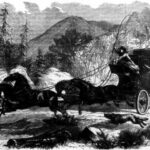
The illustration below appeared on the front page of Ballou’s Pictorial on March 6, 1858. The Globe used a version of the same scene alongside Spratt’s reminiscence in 1893.
Wolves surround a horse-drawn coach while a passenger fires a gun. The accompanying 1858 article said a newspaper account circulating through the press had supplied its artist, identified as Mr. Hill, with the subject.
Ballou’s approved of the result: “It is a perfect romance of the highway.”

The 1858 article names neither Spratt nor the Airline. The picture shows how the wolf stories reached readers; it doesn’t establish an attack on his coach.
Passengers made out of mail
Spratt’s account said his competitors also cut rates, but the Air Line gradually won a reputation as a quick, short Down East route.
One unnamed driver in Spratt’s story made passengers out of the mail. He dressed his well-filled mailbags in men’s clothes and propped them on the seats so they would resemble men.
The driver later claimed that would-be robbers saw the apparent passengers and left the coach alone.
If the story happened as he told it, the mail was protecting its driver. I have to admire that security detail.
Liked this one? Get more tomorrow.
Lost Maine stories in your inbox most mornings: the newest, plus a few from the archive.
 This storyThe Stagecoach Rivalry Behind Maine’s Airline Road
 Maine’s Moose Lottery: The Moose Wake, the Moose Suit and the First Hunt in 45 Years
 The Witch’s Curse of Bucksport: The Leg on Jonathan Buck’s Tomb
Free. Unsubscribe anytime.
AI helped research and write this story. Here’s how we use AI.Suggest a correction