

Did you know there’s an island off Rockland where, in 1942, you needed a license for your dog but not for your car?
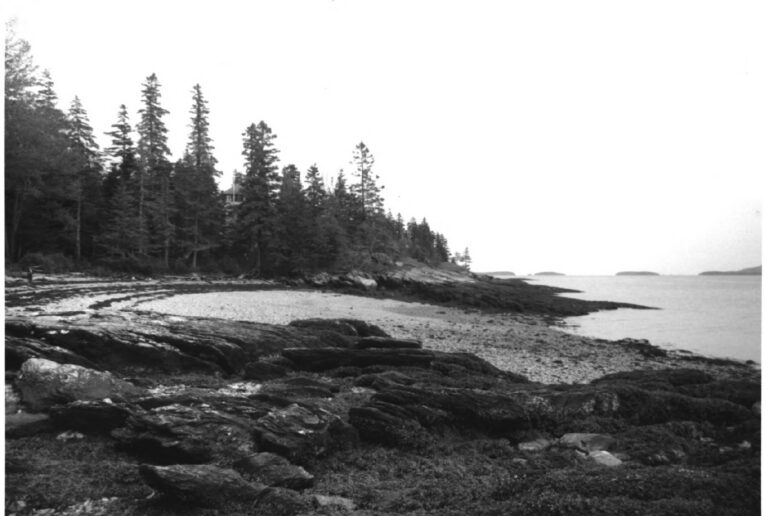
That’s Matinicus. The Island Institute calls it the most remote year-round island in Maine, about 20 miles out past Owls Head. The census finds only about 50 people living there today, and far fewer stay through the winter. There’s no power line to the mainland, and the mail comes by plane. Not every island town out here made it. Not far away in Penobscot Bay, Hurricane Island went from a granite town to a single voter by 1916.
About five miles farther out sits Matinicus Rock, a treeless ledge with a lighthouse and a teenage keeper you won’t forget.
We went through a century of newspapers, a 1926 island history and the lighthouse records. These are the 14 things that surprised us most.

Did you know the whole island was deeded for $18?
From the 1750s until 1825, the families on Matinicus had no legal title to their own land.
That changed after a legislative resolve of February 14th, 1825. On August 10th, 1825, the state’s land agent signed a deed handing the whole island, “about 700 acres,” to the people already living on it. The price was eighteen dollars, according to Charles A. E. Long’s 1926 history, Matinicus Isle: Its Story and Its People.
In 1840 the island was organized as a plantation. That’s a uniquely Maine form of local government, a small town with its own elected officers and clerk but without a full town charter. Matinicus Isle Plantation still runs that way today.

The first settler died after a siege that lasted days
Ebenezer Hall, originally of Falmouth (now Portland), came out to Matinicus by way of Small Point and Pemaquid around 1750. Long calls him the island’s first permanent settler.
He was not welcome. At a treaty conference in October 1752, the Penobscot leader Col. Louis complained that Hall and his family on Matinicus were getting in the way of their seal hunting and bird hunting.
The next spring, Penobscot leaders wrote to the governor and demanded that Hall be removed within two months. A 1754 affidavit says Hall and his son had shot two Native men in 1751.
In June 1757, a war party landed. Hall tore a board off his own roof so the house couldn’t be set on fire and fought back through a loophole for days. A letter written that month by Enoch Freeman says the attackers finally “sent a Ball through his Head and kill’d him dead on ye Spot.”
His wife and the children with her were carried off. His stepson, Joseph Green, slipped over a wall and paddled about six miles out into the bay on a raft before a fishing schooner picked him up.
Mary Hall was taken to Quebec, ransomed, and came home by way of England and New York, about 18 months later. She never saw the children taken with her again.
Did you know the island “king” was chosen by a shouting contest?
Hall’s grown son, Ebenezer Jr., had been away fishing during the attack. He came back to Matinicus in 1763 with his wife, Susannah. In 1765 her sister Phoebe arrived with her husband, Abraham Young.
Between them, the two sisters raised 15 and 13 children. Long’s comment, more or less, was read it and weep.
Now the legend, which Long credits to a descendant of both families. Old Hall and old Young climbed the island’s high point, Mount Ararat, to settle who would be “king” of Matinicus by seeing who could shout the loudest.
Young lifted up his voice in an “ungodly yell.” Hall gave in and conceded the Youngs’ supremacy, as Long put it, “in all matters pertaining to hollering.”

One election, 33 votes, one party
In the presidential election of November 1844, Matinicus cast exactly 33 votes, and every one went to the Democratic electors pledged to James K. Polk.
The plantation clerk added a note to the return, quoted by Long, saying every voter on the island was a Democrat.
It didn’t last. By 1876 the island split 26 to 25, and by 1926 Long reported it was solidly Republican.
Matinicus Rock once had two lighthouses
Matinicus Rock was first lit in 1827, with two wooden towers at either end of a cobblestone house.
According to its National Register nomination, it was then the most distant light from the mainland, and the first to use a pair of towers. The granite house that still stands there was built in 1847, from a design by Alexander Parris.
New granite towers went up in 1857, 180 feet apart. In 1926 Long noted that not one tree or shrub of any kind had ever managed to take root there.

The two lights burned side by side for most of a century. Long says the north light went dark for good on August 15th, 1923, though the Coast Guard’s history puts it in 1924. The empty tower is still out there.

A 17-year-old kept both lights burning through the storm of 1856
In January 1856, keeper Samuel Burgess crossed to Matinicus Island. He left his 17-year-old daughter Abbie in charge of the lights, along with her invalid mother and her younger sisters.

Then the weather turned. On January 19th, the sea broke right over the Rock.
Abbie described it later in a letter, reprinted by the U.S. Lighthouse Society in its Keeper’s Log.
“Early in the day as the tide rose, the sea made a complete breach over the rock, washing every movable thing away, and of the old dwelling not one stone was left upon another… As the tide came the sea rose higher and higher, till the only endurable places were the light towers. If they stood we were saved, otherwise our fate was only too certain.”
The family rode it out in the towers while the old cobblestone house came down. For four weeks no boat could land, and her father couldn’t get back. Through all of it, Abbie wrote, the lights never failed once.
Did you know she ran into the waves to save the chickens?
This is our favorite part.
The family’s hens lived in a coop down among the boulders. “You know the hens were our only companions,” Abbie wrote. Between waves she ran out to the coop through knee-deep water and saved all but one.
Moments after she got back inside, her little sister cried out at the window, “Oh look! Look there! The worst sea is coming.” That wave finished off the old house.
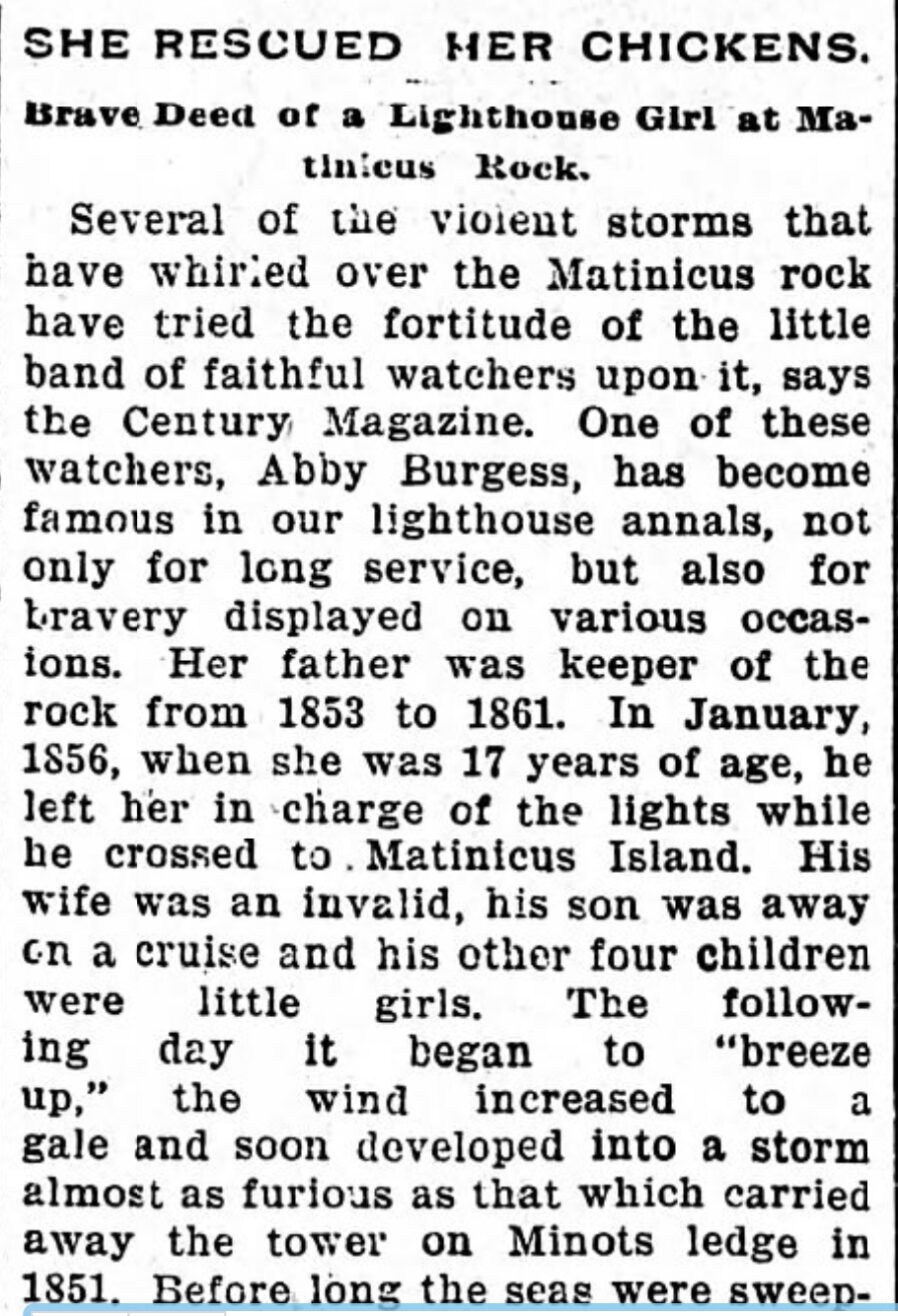
Forty years later the story was still making the papers. In the summer of 1897 it ran across the country under a headline about how she rescued her chickens, drawn from an article in Century Magazine. The Appeal of St. Paul, Minnesota, explained to its readers that on a lonely outpost like Matinicus Rock, “a chicken is regarded with affectionate interest.”
Abbie stayed on the Rock after her father left the job in 1861. She married Isaac Grant, son of the new keeper, and served as his assistant. They later moved to White Head Light and retired in 1890.
She asked for a lighthouse on her grave
Late in life, Abbie wrote that she still dreamed about the old lamps on the Rock. She remembered there being 14 lamps and 14 reflectors.
She died in 1892. Five years later, a letter of hers was printed in which she wrote:
“If I ever have a gravestone, I would like it in the form of a lighthouse or beacon.”
Half a century later, the lighthouse historian Edward Rowe Snow took her up on it. On November 21st, 1946, an AP story on the Portland Press Herald’s front page reported the news. Capt. Joseph Noden of Saugus had built a 14-inch aluminum replica of the Matinicus Rock light.
It was to be dedicated on her grave at Spruce Head at 3 o’clock that Saturday, November 23rd. Some later accounts put the memorial in 1945.

The Coast Guard went one better. In 1998 it commissioned a buoy tender named for her, the USCGC Abbie Burgess, homeported in Rockland.
Did you know the terns on Matinicus Rock attacked the lighthouse keepers?
On July 16th, 1905, the Boston Sunday Globe ran a full feature on the Rock’s seabirds, under a headline calling the place a nursery of cunning “Medric Babies.” “Medric” is an old name for the tern.
About 5,000 terns and gulls nested there. They were protected by law, and the head keeper himself was one of 12 bird “wardens” on the coast. The terns didn’t care.
“A little mother tern, frail as a toy… believes herself a match for any sturdy lightkeeper who may presume to come out of doors to hang out clothes, or otherwise to attend to his own business. She can drop out of a clear sky with wheeling wing and dexterous rudder-tail and all but reach his forehead with her keen, long, red bill, opened wide as she comes.”
Sometimes, the Globe admitted, she actually lands a peck.

Matinicus Rock helped save Maine’s puffins
By 1900, hunting, egg collecting and sheep had nearly wiped out Atlantic puffins in Maine. According to the state’s Department of Inland Fisheries and Wildlife, puffins hung on in the Gulf of Maine at only two places, Matinicus Rock and Machias Seal Island, where the lighthouse keepers protected them.
Today the Rock belongs to the Maine Coastal Islands National Wildlife Refuge. The refuge’s 2009 report put the puffins there at more than 350 pairs, alongside 389 pairs of razorbills.

The island next door was once “Ragged Arse”
Matinicus has a little neighbor about two miles to the south, now called Criehaven.
Its Native name, Racketash, got bent by English-speaking sailors into something saltier. When Maine and Massachusetts divided up the coastal islands, the list included a 217-acre Ragged Arse Island, according to Long.
The name was later cleaned up to Ragged Island. The village became Criehaven, after Robert Crie, who had bought the whole island by 1879.

Santa came to Matinicus by boat
For years, Christmas on the outer islands arrived on a mission boat.
On December 21st, 1931, a wire story carried as far away as Windsor, Ontario, reported on the island’s Christmas. Matinicus Island’s 30-odd children, it said, looked “not up the chimney, but out to sea” for Santa Claus.
They were watching for the 80-foot cruiser Sunbeam of the Maine Sea Coast Missionary Society, known among island families as “God’s yacht.” On board was the Rev. Orville J. Guptill with 2,000 gifts of food, clothing and toys for the islands and coast between the St. Croix and Kennebec rivers.

1942: blackout rules, carrier pigeons and four working cars
In May 1942, Wide World reporter Frank Carey made a three-hour motorboat run from Port Clyde to see how Matinicus was handling the war. His story ran in the Portland Sunday Telegram on May 10th, 1942.

He found 75 people, blackout rules lying on the table next to the family Bible, and lobstermen who said that if a submarine tried to take their harbor, they’d “kinda resist ’em.” Then he got to the details that make this one of our best finds.
“There are only eight or nine automobiles on the island, ‘only four of ’em are running,’ and you need no license for your automobile although you do have to license your dog… You learn that there have been only three fires on the island in all history; that people never lock their doors at night, and that the plantation constable’s only business in the last five years has been the serving of three process papers.”
There was a telephone cable to the mainland by then. Carey wrote that not long before, islanders had used carrier pigeons to call a doctor out from the mainland.
The school was down to nine pupils. Selectman Edwin Riley grumbled that paying a $25-a-week teacher for so few children “is like hunting rabbits with a 16-inch gun.”

Matinicus still makes its own electricity
There’s no cable to the mainland grid. The Matinicus Plantation Electric Company makes the island’s power with diesel generators, which were replaced in 2025, when battery storage was added too.
The Maine Monitor reported in April 2026 that islanders pay about 30 cents a kilowatt-hour, more than twice the mainland rate. Until the 1960s, households that wanted power ran their own generators.

The mail used to come on Steamboat Day, aboard the W. G. Butman, until she sank in 1916. Now Penobscot Island Air flies it out from Knox County Regional Airport, and the state ferry from Rockland runs about once a month in winter.
The carrier pigeons, at least, have retired.
Lost Maine stories, in your inbox.
The newest story, plus a few from the archive.
Free. Unsubscribe anytime.
We use AI to help research, write and edit stories across our sites. Here’s how we use AI.Suggest a correction