

Almost every city in America has an airport. Portland, Maine, has a jetport. And the three letters on your luggage tag, PWM, don’t stand for anything you’d guess.
Let’s start with PWM. According to jetport director Paul Bradbury, it comes from an older name, Portland-Westbrook Municipal. The Westbrook part came from a lighted airway beacon in that town, and the beacon is long gone, but the letters stayed.
The “jetport” part dates to April 1969. On Saturday, April 26th, Stephen Schmitt, the city’s director of aviation and public buildings, revealed the new name. Portland Municipal Airport would now be the Portland International Jetport, as a Maine Sunday Telegram brief reported and the Portland Press Herald recounted in 2020.
The jets had arrived the year before. In 1968, after runway extensions, a new terminal opened and Northeast Airlines started DC-9 jet service. A Northeast sales manager, Richard Jones, wrote in a June 1968 column that it would “thrust Greater Portland firmly into the jet age.”
And the “international”? Schmitt said it was there because customs and immigration service had long been available at the airport.
Is it the only jetport?
No, and it wasn’t the first. Merriam-Webster dates the word “jetport” to 1956. On December 3rd, 1959, the Newark Evening News ran the headline “PLAN JETPORT IN MORRIS COUNTY,” about a Port of New York Authority scheme to build one in New Jersey’s Great Swamp. Neighbors fought it, and it was never built.
Washington went through the same fight a few years earlier. Its second airport was planned for Burke, Virginia, until neighbors pushed back and Eisenhower moved it out to farmland in Willard, where it became Dulles.
A handful of airports still carry the name. Most are smaller fields in North Carolina, like the Kinston Regional Jetport and the Raleigh Executive Jetport, plus the Cleveland Regional Jetport in Tennessee. Others, like Millington in Tennessee, dropped it.
What makes Portland’s different is that it’s a real commercial airport. The Federal Aviation Administration’s 2025 list of commercial service airports runs to more than 500 names, and Portland International Jetport is the only jetport on it. Pretty wild, right?
So how did a field at Stroudwater become Maine’s busiest airport? It started with a dentist who liked to fly.
A dentist’s landing field
Dr. Clifford “Kip” Strange, a Portland dentist, cleared land in Stroudwater, on the western edge of the city, so he’d have somewhere to land his plane.
By January 1926 other people were taking it seriously. On January 26th, 1926, the Daily Kennebec Journal ran an Associated Press report on the deal. Lieutenant Robert W. Lowell of Bangor, president of the Maine Aerial Service, Inc., had made arrangements with Strange to set up an airport at Stroudwater. It would be a landing place between the Boston and Bangor airports.
That summer the field hosted something that looked a lot like a publicity stunt. On July 30th, 1926, the Kennebec Journal reported that a plane would land at the Stroudwater field carrying what it called the largest single shipment of merchandise ever sent by air to one merchant in the United States.
The merchant was the J.R. Libby department store in Portland. And the cargo? It was several hundred dresses from New York.
The plan was to fly the dresses to East Boston by U.S. mail plane, then switch them to a Colonial Air Transport plane for the trip to Stroudwater. City officials and a member of the Governor’s Council would be waiting at the field. Ralph G. Libby of the store swore it wasn’t a stunt:
We are not doing this for an advertising or publicity stunt, but to show that the merchants of Maine are progressive and are looking forward to meeting the demands that are being made on them increasingly each year.
The Journal also said Colonial’s managing director, “J. T. Tripp,” would ride along personally. That’s almost certainly Juan Terry Trippe, then a vice president and general manager of Colonial. In 1927 he formed Pan American Airways, with himself as president, according to Encyclopaedia Britannica.
And it worked. Portland’s Victoria Mansion keeps a photo of the biplane after it landed, with Ralph G. Libby among the men lined up in front of it. The museum calls it the first delivery of cargo by air to Portland.
Lindbergh and the Scarborough airport
Strange’s strip wasn’t the city’s airport, though. In the late 1920s Portland’s new airport was being built in Scarborough.
Charles Lindbergh (yes, that Charles Lindbergh) tried to fly in there in July 1927, two months after his flight to Paris, while it was still under construction.
Fog balked him two days running. He came down on the beach at Old Orchard instead, and the Spirit of St. Louis spent the night in a hangar there. Here’s the scene on the morning of July 25th, 1927, as the Associated Press reported in the New Britain Herald:
The crowd of 40,000 persons packed on the mile long stretch of sand pressed forward and the local police, augmented though they were by state and Biddeford officers, were unable to keep them back.
Once he got off the sand, he circled Portland, dipped his wings over the cruiser Seattle in the harbor, and paid a brief official call at Portland’s new airport in Scarborough, the AP reported. The Scarborough Historical Society says he reached the field by motorcade.
The Scarborough Historical Society dates the field’s dedication to September 28th and 29th, 1928. Within ten years it was too small for the bigger planes, with no room to grow.
The airlines arrive
Airline service arrived on August 1st, 1931. That day, the International News Service reported, tri-motored planes took off from East Boston for Portland, Rockland and Bangor. They were the first daily flights of Boston-Maine Airways, run jointly by the Boston and Maine Railroad, the Maine Central and Pan American Airways.
The July 1931 announcement named Pan American’s president: Juan T. Trippe. So the man who promised to ride along with Libby’s dresses in 1926 had a hand, it seems, in Portland’s first airline five years later. How about that?
Where those first planes landed in Portland is a little murky. The Kennebec Journal’s “On this date in Maine history” column places the August 1931 flight at Stroudwater. The Maine Historical Society says regular airline service moved from Scarborough to Strange’s field in 1934. Either way, by the mid-1930s the airlines were at Stroudwater.
The service was dropped in 1932, then came back in August 1933. The Associated Press noted that it was the first airline ever run by a railroad, and a famous name was on board. Amelia Earhart, “famous woman flyer,” would be guest pilot on a preliminary flight that Wednesday, the AP reported.
The actual flying was done by National Airways, a company headed by Paul Collins. Earhart, the Washington Daily News reported, was actively involved in running it and served as one of its vice presidents.
The city bought the field in the mid-to-late 1930s (sources give 1936, 1937 and 1938). In 1940 the Works Progress Administration built Portland’s first real terminal, a brick building that still stands as the general aviation terminal. The airline got a new name that year, too. In November 1940, Paul Collins’ Boston-Maine-Central Vermont Airlines became Northeast Airlines.

July 11th, 1944
The darkest day in the airport’s history came during World War II.
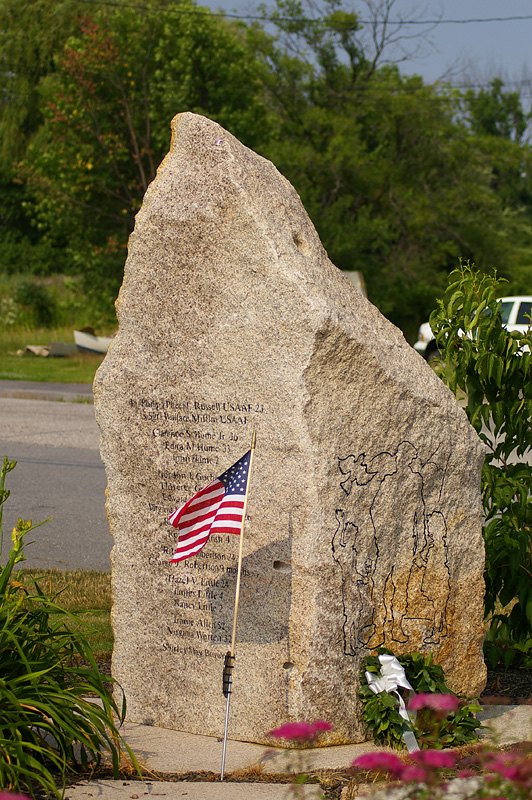
Late on the afternoon of July 11th, 1944, an Army A-26 bomber from Barksdale Field, Louisiana, tried to land in fog. It missed the field and plowed into the Westbrook Trailer Camp, home to shipyard workers’ families in South Portland. Here’s how the Associated Press described it in the Evening Star the next day:
It appeared to have been in trouble as it banked over the airport and then disappeared in a fog bank to crash and explode almost immediately afterward.
The AP counted 16 dead that day. The toll kept climbing. Nineteen people died in all: the two airmen and 17 men, women and children on the ground. It’s still the worst airplane disaster in Maine’s history.
The trailers were lightly built, and they burned. One engine, the AP reported, “hurtled through one trailer,” missing a mother and child lying on a couch by only a few feet.
The pilot was Lt. Philip Russell, 23, of South Portland. His wife, the AP reported, was waiting at the airport with her 3-month-old child when it happened. She heard the plane plunge into the trailers after it vanished into the fog.

On July 11th, 2010, 66 years to the day after the crash, the Long Creek Air Tragedy Memorial was dedicated in South Portland.
The Muskie Airport, for three weeks
Fast-forward to 1982. The Jetport name survived one serious challenge.
On February 1st, 1982, the Portland City Council voted to rename it the Edmund S. Muskie International Airport. Muskie, a former U.S. senator from Maine, had recently left the job of President Carter’s secretary of state.
The backlash was intense, and Muskie himself asked the council to undo it. He wrote that, to his dismay, he found his name caught up in an unpleasant controversy. “In any case, I want no part of it,” he added.
The council rescinded the change before the month was out … and the Jetport was the Jetport again.
The airport isn’t Maine’s only name with a story behind it. We’ve also traced the names of Maine’s towns named for countries and foreign cities, and the Walker family behind the name Walker’s Point.
Still a jetport
The DC-9s that earned the name in 1968 are long retired. The name isn’t, and neither are the letters on your bag tag.
The terminal has grown several times since then, most recently with a $75 million addition that opened on October 2nd, 2011. In 2018 the Jetport handled more than 2 million passengers in a single year, a record.
And Kip Strange’s landing field is still right where he put it, on the edge of Stroudwater.

Lost Maine stories, in your inbox.
The newest story, plus a few from the archive.
Free. Unsubscribe anytime.
We use AI to help research, write and edit stories across our sites. Here’s how we use AI.Suggest a correction