

Maine had banned liquor sales for drinking in 1851. Bangor had nearly 200 places to buy a drink anyway.
That count comes from a correspondent for The Sun in New York, writing in December 1897. He found nearly 200 retail outlets, plus several wholesale houses.
So how did the Queen City keep that many places selling liquor in a dry state, year after year, in plain sight? It had a system known as the “Bangor plan.”
The fine that worked like a license
The Sun laid it out on December 12th, 1897, in a dispatch datelined Bangor, December 10th:
In Bangor very little attention has been paid to the law for twenty years, or since the time of the famous Sheriff Jerrard. By common consent liquor selling is allowed, under certain police regulations …
This was not some bootlegger’s dodge. The Sun said the plan was generally credited to Chief Justice Peters of the Maine Supreme Judicial Court, who made his home in Bangor. Yes, you read that right. That was Maine’s top judge.
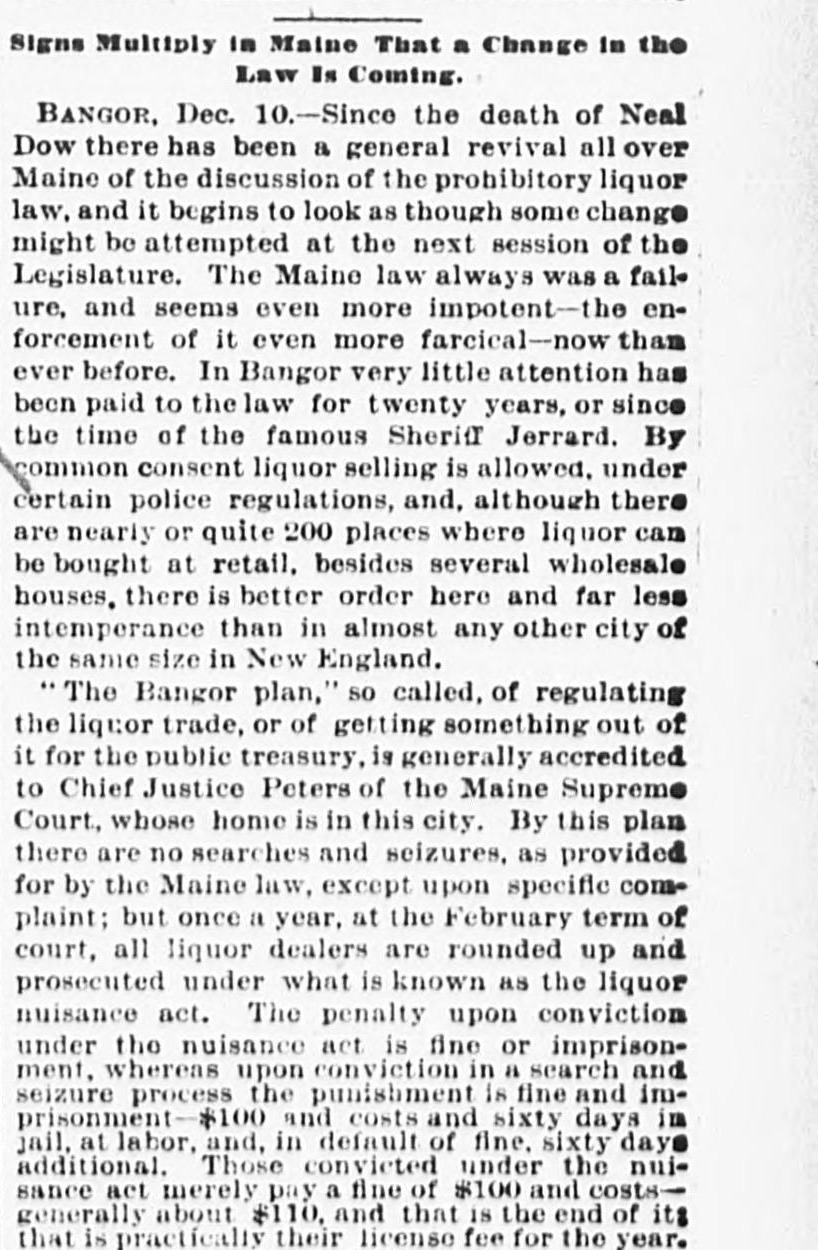
Here’s how the Sun explained the choice of charges in 1897. A conviction in a “search and seizure” case meant a fine and jail. A conviction under the liquor nuisance act allowed a fine or jail, not both.
Under the Bangor plan, there were no raids unless somebody filed a specific complaint. Instead, according to the Sun, every liquor dealer in town was rounded up once a year at the February term of court and prosecuted under the liquor nuisance act.
So the dealers paid a fine of $100 and costs, generally about $110 in all, and went back to work. The fine, the Sun said, was “practically their license fee for the year.”
The list came from the federal tax man
Now here’s the part I love. Nobody had to catch anyone selling a drink.
Portsmouth, New Hampshire, was where the federal revenue collector for the district kept his books. Here’s how the Sun described the sheriff’s yearly errand:
The Sheriff goes to Portsmouth, N. H., and copies from the books of the Collector of Internal Revenue for this district a list of those in Penobscot county who have paid the special United States tax as dealers in liquors.
Think about that. Selling liquor was illegal in Maine, but the federal government still collected its special tax from anyone in the liquor business (legal or not). The dealers paid it. Bangor simply used the federal list as its roster of defendants.
A name on that list, the Sun explained, was taken as prima facie evidence that the man was in the liquor business, and he was indicted on that basis. In other words, paying your federal tax was enough to get you charged.
The Sun even claimed that, for all those bars, Bangor was orderly. It said the city had better order and far less intemperance than almost any other New England city its size. Hard to picture, isn’t it?
It also paid. The Sun described the plan as a way to get something out of the liquor trade for the public treasury.
And the idea spread. The Sun reported it had been adopted in Androscoggin County and some other counties, and was now popular in Cumberland County, home of Portland.
Not everyone admired it. The Portland Express, in an editorial reprinted by the Daily Kennebec Journal on August 11th, 1897, called it a systematic disregard of the law. Its account described dealers paying fines two or three times a year, rather than the annual arrangement the Sun described. Either way, the complaint was the same: a fine had become permission to keep selling.
“Famous ‘Bangor Plan’ Busted”
In February 1903, one judge tried to break that arrangement.
The case of Robert Brown, a Bangor wholesale liquor dealer, came before Justice Albert M. Spear of the Maine Supreme Judicial Court. Wholesalers paid more than the corner saloon. County Attorney Smith told the court that the usual fine of $200 was far too small.
Brown’s lawyer argued for the Bangor plan. According to the Portland Daily Press, he said the plan had always worked well and that the liquor dealers were good fellows who paid their fines promptly.
Justice Spear was not interested. He said he was proceeding under the statutes and the constitution, “and not according to the ‘Bangor plan.'” He fined Brown $800 and costs. If Brown didn’t pay within ten days, he would serve eight months in jail at hard labor.
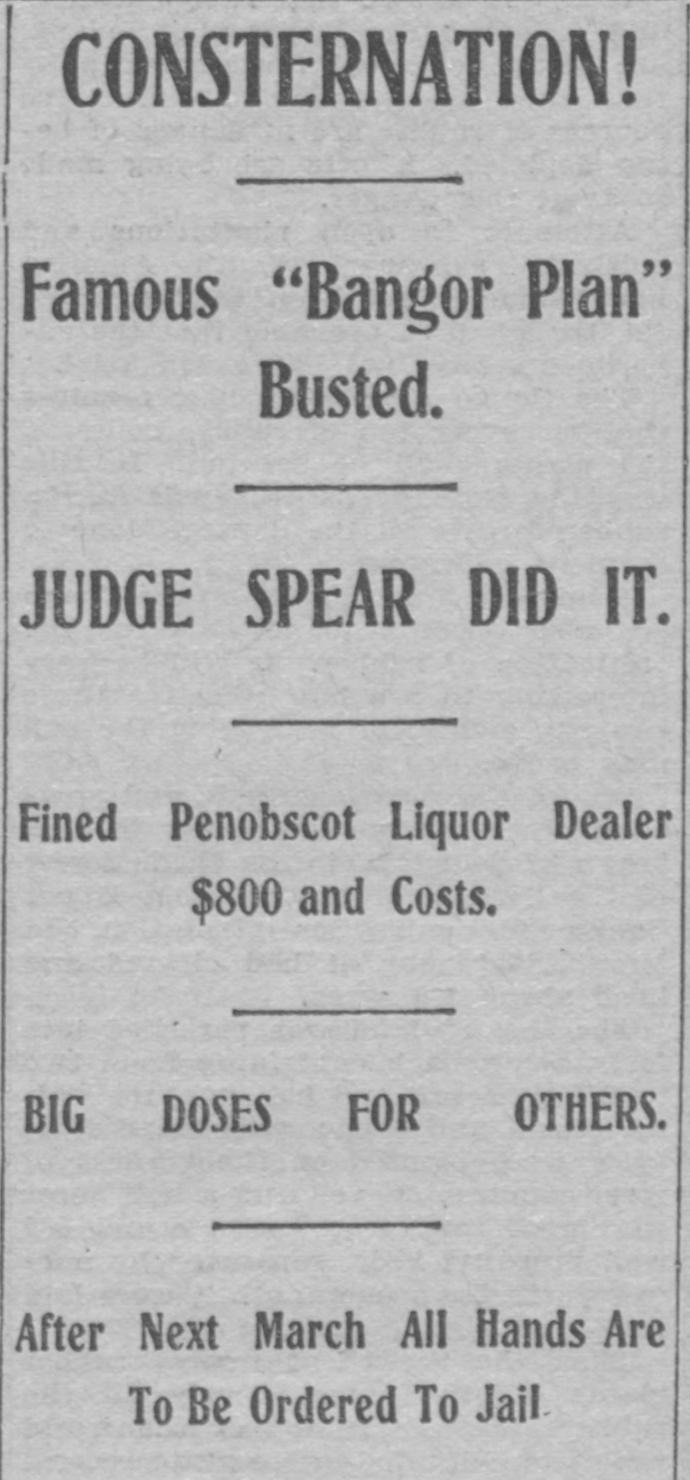
The Press reported from Bangor that night:
The other liquor dealers in court were dumbfounded, and general consternation prevails.
The Press reported that retailers were expected to be fined $400 each, and that after March 1st the sentence would be jail, with no alternative. It concluded that “the ‘Bangor plan’ is dead and buried.”
A week later, the Somerset Reporter in Skowhegan cheered the alarm the ruling spread among Bangor’s lawbreakers. But its report put the actual fines and costs at $810 for wholesalers and $210 for retailers, below the $400 retailer fine the Press had predicted. Most dealers settled, it said, and that session of court brought in $28,000.
The fines got bigger. The dealers paid them … and they kept selling.
Dead and buried? Not quite
By December 1912, nearly a decade after Spear’s ruling, Bangor was still wet. At a city hearing on December 27th, Police Chief Frank Davis described the “unwritten law” he and the mayor had agreed on. Saloons were to close at 10 p.m., stay shut on Sundays and run clean places. Police had tolerated them, he admitted, as they had for decades.
That account comes from Bangor historian Wayne E. Reilly, writing in the Bangor Daily News. The state was about to lose patience.
In April 1913, Gov. William T. Haines and the Legislature went after Penobscot County’s sheriff, Wilbert W. Emerson, charging him with willful and corrupt neglect in enforcing the prohibitory law.
Bangor was a lumber town, and its thirstiest customers came out of the woods. That April, Bangor’s Judge Louis Stearns defended the Penobscot sheriff before the Legislature. According to the Kennebec Journal’s account, he pointed to the thousands of “men from the woods” who poured into the city twice a year, many of them with no homes of their own.

Emerson had been in office about three months. Judge Stearns asked legislators to “Give him time.” They didn’t. On Friday, April 11th, 1913, the Legislature in joint convention voted 80 to 32 to ask the governor to remove him.

Emerson’s deputies started raiding on Saturday, April 12th. On Monday, April 14th, the Bangor Daily News front page announced “BIG DROUTH BEGINS IN BANGOR TODAY.” (That’s “drought” in 1913 spelling, and what a headline.) Many saloons had closed and shipped their stock back to Boston, Reilly found.
It didn’t save Emerson. Maine’s Executive Council, which had to approve the governor’s actions, voted to have Haines remove three sheriffs: Penobscot, Cumberland and Sagadahoc. Haines’s letter informed Emerson that he was removed as sheriff of Penobscot County, effective May 8th, 1913.

Emerson’s successor, J. Fred O’Connell, kept up the raids. By the end of 1913, the Bangor Daily News judged that the city was as dry as an honest sheriff, actively enforcing the law, could make it, according to Reilly.
The mayor who counted 180 saloons
It didn’t last. By the fall of 1914, after months of pressure from ministers and reformers, Bangor’s mayor, John G. Utterback, had seen enough.
In late October 1914, he gathered nearly every officer and patrolman at City Hall. From November 1st, he told them, the prohibitory law would be enforced absolutely, and he would hold the city police department responsible.

According to the report, the mayor said new saloons were opening often, that some stayed open all night and on Sundays, and that they sold to boys and drunken men. Bangor had made 2,700 arrests for drunkenness in under ten months, compared with 2,100 in all of 1913. That’s a lot of drunkenness for a dry city!
He was blunt with a reporter. “We are not to have ‘regulation’ or anything of the sort,” he said.
Instead, he promised, Bangor would have absolute prohibition around the clock. He admitted that making the city dry wouldn’t be easy, and said he didn’t underestimate the size of the job.
On Tuesday evening, October 27th, 1914, Utterback took his ultimatum to the Maine State Sunday School Association at the Columbia Street Baptist Church. He said there were 175 or 180 saloons in a city of 25,000, the Kennebec Journal noted in an editorial two days later. He had ordered the city police into open war on the saloons.
How it ended
Utterback lost the next mayoral election. According to Reilly, Democrat Frank Robinson won in the spring of 1915 with 2,005 votes, while Utterback came second with 1,575.
The city police stepped back. Enforcement was left to the county sheriff again, and Bangor returned to “regulating” its saloons.
National Prohibition arrived in 1920 and ended in 1933, but Maine still had prohibition in its state constitution. On September 10th, 1934, Maine voters voted to remove that clause, 161,893 to 85,363.
By the September 1934 vote, Utterback was in Washington, serving his single term in Congress. Maine had finally voted to change the rule Bangor had spent so many years getting around.

Portland had its own liquor raids, including those led by Officer Willard Frith. Bangor’s police history took a different turn in 1937, when the Brady Gang came to town to buy guns.
Liked this one? Get more tomorrow.
Lost Maine stories in your inbox most mornings: the newest, plus a few from the archive.
 This storyThe Bangor Plan: How Saloons Stayed Open in a Dry State
 Maine’s Moose Lottery: The Moose Wake, the Moose Suit and the First Hunt in 45 Years
 The Witch’s Curse of Bucksport: The Leg on Jonathan Buck’s Tomb
Free. Unsubscribe anytime.
AI assisted editing and source review. The featured photograph was restored and colorized with AI; colors and reconstructed details are interpretive. The original black-and-white photograph is retained in the article. Here’s how we use AI.Suggest a correction