

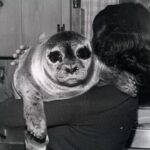
Visitors at the New England Aquarium in Boston kept hearing a man’s voice by the seal pool. It was gruff and deep, with a New England accent, and it said things like “Hello there!” and “Get out of here!”
There was no man. It was a harbor seal named Hoover.
The Maine couple who raised him said he picked it up in Harpswell, at their house on Bethel Point Road in Cundy’s Harbor.
You can hear Hoover in a 1984 recording preserved by Boston University’s Guenther Speech Neuroscience Lab. The sound is rough, but that gruff voice comes through.
A pup on the shore at Cundy’s Harbor
On Friday, May 14th, 1971, Ralph Dunning of Cundy’s Harbor found a baby seal on the nearby shore. Nobody knew where the mother was. The Portland Press Herald reported that she had either abandoned the pup or been shot by a fisherman.
The pup went to Dunning’s sister, Alice Swallow, and her husband George, who lived on Bethel Point Road in Harpswell. The map below shows Bethel Point and nearby Cundy’s Harbor.

“Just like a vacuum cleaner”
At first, the pup wouldn’t eat.
“We tried to feed it milk from a bottle but were unsuccessful,” Mrs. Swallow remembered. “When we discovered the seal was not going to accept the food, we forced milk and fish down his throat.”
It worked. Soon the seal was eating three or four mackerel or other small fish, three or four times a day. (He did not like alewives.)
So they named him Hoover, because “he eats everything in sight just like a vacuum cleaner.”

He started out in the Swallows’ bathtub. On Monday, May 17th, they moved him to the freshwater pond behind the house. On sunny days, he lay on a flat rock about 30 feet from the edge and flopped into the water when he felt like a swim.
He even went to school. On Tuesday, May 18th, the children at the Harpswell Island Elementary School examined him all morning. His reward was an extra helping of fish. Then, the Press Herald reported, he had a long drink of water, let out a burp and went back to his rock.
Here’s one thing that doesn’t line up. In May, the Press Herald said Hoover weighed about 25 pounds. In August, the same paper said he weighed 10 pounds when he first arrived at the Swallows’. Either way, he was a growing boy.
“Hey, hey stupid”
Hoover lived like a family pet that summer. Alice Swallow told the Press Herald that when they opened the kitchen door, he would come right in.
George Swallow said later that he spent almost every hour with the seal while Hoover lived with them, and he talked to him constantly.
Years later, he told The Times Record of Brunswick about those feedings. He would step off the porch and call out, “Hey, hey stupid.” Hoover would peer up, then duck back into the cattails. So George would walk closer and say “Get out of here,” and out Hoover came.
George later recalled thinking he had heard Hoover try to say his own name while the seal lived with them. He thought that was impossible and let it go.
By August, the Swallows had a problem. Hoover was expensive to feed, and their pond would freeze in winter. And a seal this tame might not survive back in the sea. On Monday, August 16th, 1971, they drove him to the New England Aquarium in Boston.
“I certainly miss him, I cried the day he left,” Alice told the Press Herald. When the aquarium weighed him, he was up to 48 pounds.
From Casco Bay to Boston Harbor
For a few years, Hoover was just another seal in the aquarium’s outdoor pool. Then, around 1977, staff started to notice something.
Patricia Fiorelli, who ran the aquarium’s marine mammal stranding program, penciled a question in her notebook. Was he saying something?
He was.
Boston’s talking seal
By the summer of 1981, Hoover was national news. Here’s how United Press International opened its story:
“Hoover, a plump harbor seal, has the unnerving ability to clearly say ‘Hello there,’ or ‘Come over here,’ whenever he feels like it.”
UPI added that visitors were often shocked.

He could also ask how you were and say his own name. The UPI reporter said he sometimes let out a laugh like Arte Johnson’s dirty old man on “Rowan and Martin’s Laugh-In.” (Remember that one?)
Fiorelli told UPI that visitors had their own theory:
“He’s been mimicking sporadically for the last two to three years. A lot of people think there’s a little man down there trying to hoodwink them.”
Scientists took it seriously. Katherine Ralls, a research zoologist at the National Zoo in Washington, made high-quality tape recordings of Hoover and studied them with equipment normally used for bird songs. His mimicry, she said, was “much better than parrots.” Ralls had another description:
“He sounds like some old wino … We’re going to compare them with a human voice model, and thinking of using the same kind of analysis the FBI uses for voice prints.”
How great is that? A seal from Cundy’s Harbor, up for the FBI voice-print treatment.
“He sounds like me all the time”
By February 1983, the Swallows had a tape recording of Hoover saying his name in a husky, deep voice with a New England accent, then laughing, The Times Record reported.
It was Hoover, but it sounded like George.
“He sounds like me all the time,” George Swallow told The Times Record in February 1983.

That week, the Swallows were booked on national TV. ABC’s “Good Morning America” and its host, David Hartman, invited them on the show for Friday, February 4th, 1983, with Hoover joining from his tank in Boston.
George thought he’d heard something during Hoover’s months in Harpswell, but the aquarium’s records showed no talking until the seal was about 5. Liz Kay of its community relations department told the paper in 1983 that scientists still had no explanation after six years of study.
George had his own answer. “We won’t say we taught him, because we didn’t, he just picked it up.”
Hoover goes quiet
Hoover died on Thursday, July 25th, 1985. He was 14.

The Associated Press called him the aquarium’s mascot and said he had delighted 900,000 visitors a year. Several of his offspring were still in the seal pool at the aquarium’s entrance.
Hoover wasn’t the end of the family’s vocal talents. The New England Aquarium says his grandson Chacoda has also learned to imitate a few phrases.
Back in Harpswell
The aquarium tells Hoover’s story on its website, alongside information about its harbor seal exhibit. Check there for current visiting information.
And Cundy’s Harbor is still a fishing village, with boats on their moorings near the shore where Ralph Dunning found a pup in 1971.

Next time you drive out to Cundy’s Harbor, say hello to the seals. You never know.
Liked this one? Get more tomorrow.
Lost Maine stories in your inbox most mornings: the newest, plus a few from the archive.
 This storyHoover the Talking Seal: The Harpswell Pup Who Learned to Say “Hello There”
 Riverton Park’s Comeback, Before the Casino Came Down
 A Nazi General, Two Dead Japanese Officers and the U-Boat Brought to Kittery
Free. Unsubscribe anytime.
AI assisted editing and source review. Images are archival; none were generated or colorized with AI. Here’s how we use AI.Suggest a correction