

On Monday afternoon, July 19, 1943, the fire alarm went off in Damariscotta, and the staff of the Lincoln County News looked out the window. The Bath Daily Times described how little time they had:
Members of the Lincoln County News staff said they looked out of the window as the alarm came in and almost before they had time to look twice their building was on fire.
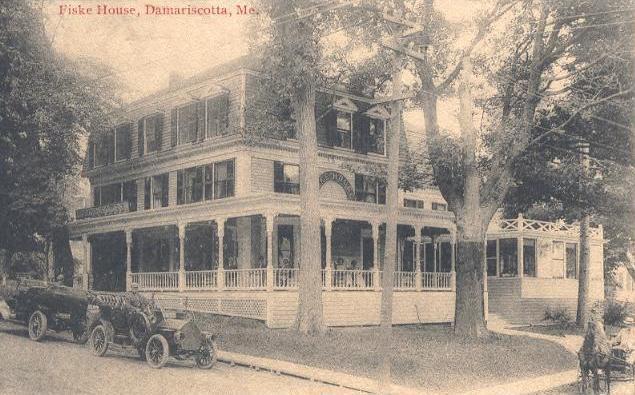
Firemen from about a dozen towns fought the blaze for three hours. The newspaper plant, a garage holding the county’s wartime ration office and four homes were lost. Fire also spread into the Fiske House, which the Army used as barracks.
Flames cut the town’s telephone wires, and soldiers were called back from maneuvers to patrol the streets.
The next edition of the News was due Thursday. Neighboring newspapers would offer their presses to help get it out.
The corner before the fire
The January 1912 Sanborn fire insurance map helps place the buildings, though it predates the fire by more than three decades. It covers both Damariscotta and Newcastle, with Main Street crossing the river between them.

At Main and Water streets, the map shows a two-story brick building marked Printing, facing the three-story Fiske House across Water Street. The News later occupied that brick building. Like the maps in our Little Canada story, its colors distinguish brick buildings in pink from wooden-frame buildings in yellow.

By July 1943, the Fiske House housed soldiers, and the Army had also taken over the Weeks-Waltz garage on Water Street, by the river.
Along New England’s coast, military and civilian forces guarded shipping lanes and watched for enemy landings as German submarines operated offshore. The fire reports don’t identify the Damariscotta detachment’s assignment or explain its use of the garage.
Inside the same garage building was the county ration office of the Office of Price Administration, or OPA, the federal agency that administered wartime rationing and price controls. Gasoline, tires and foods were rationed, making the office part of everyday civilian life.
Three clerks escaped with the tire records
David Hall, who worked at a nearby shipyard, raised the alarm. Fire Chief Millard Clark said the fire was minor when he answered the call. The station was only a few yards from the garage, but the building was in flames by the time the apparatus arrived.
Gasoline exploded in the basement, giving the fire what the Evening Express called “an immense start.” The later reports placed the outbreak in a pile of old logs behind the garage, but its cause remained uncertain. Clark suggested spontaneous combustion among logs, cans and rags; the Express’s special dispatch suggested hot ashes thrown nearby.
Three ration-office clerks, Ava Barton, Leola Hancock and Arline McKechnie, fled with time to save only the county tire records. Hancock and McKechnie had their hair singed as they escaped. OPA chief John M. Glidden said the office would be “out of business” until records could be replaced.
Embers over the village
The Post family’s home beside the garage caught almost immediately, and a wing of the Fiske House soon burned. Behind the hotel, Daniel E. Bisbee escaped his house with only a few clothes before the flames leveled it.
Across the street, the brick News building became “a mass of flames,” as the Bath Daily Times described it. Its owner, Alice M. Gray, had an apartment upstairs. The large wooden house of Mrs. Howard Hall on Main Street burned too.
Wind carried embers over the village, setting other roofs alight. Air raid wardens and civilian defense workers tackled those fires with portable hand pumps and garden hoses. The home of Samuel H. Erskine, publisher of the News, caught fire four times.
The Baptist church’s 114-foot steeple, at Main Street and Bristol Road, also caught fire. Rockland firemen saved the church, though its interior was soaked. The fire station, between the Bisbee home and the church, escaped damage.

Water from the river, soldiers in the streets
Damariscotta’s volunteers were joined by departments from about a dozen communities, including Newcastle, Bath, Wiscasset, Thomaston and Rockland. Camden sent help too, having faced its own downtown fire.
Bath sent Engine Four under Chief Richard Frates. The Bath Daily Times counted at least eight pumpers drawing from the Damariscotta River, where the high tide helped the crews. Bath Iron Works let workers from the Damariscotta area leave early to assist.
Allied bombers hit Rome for the first time that same Monday. The Lewiston Daily Sun ran the two stories together on its front page the next day.
The Bath Daily Times described the wartime scene on the village streets:
Forty Coast Guardsmen from the Rockland Section Base under Chief Boatswain Mate Levi Flint, formerly of the State Police, aided in combatting the flames and patrolled the area. Steel helmeted soldiers, carrying slung rifles, handled the crowd and guarded against any possible looting.
Hose lines impeded traffic on Main Street, which was also U.S. Route One. State Troopers and civilian defense auxiliary police from Damariscotta and Newcastle rerouted cars. At least two volunteer firemen were injured, the AP reported, including the Methodist minister, who needed treatment for shock and smoke inhalation.
The Bath Daily Times also noted the spectators:
OPA or not, a goodly number of Bath cars found their way to Damariscotta Monday afternoon and evening to survey the ruins of the $100,000 blaze which swept through the village in Lincoln county’s worst disaster Monday afternoon.
The damage was unofficially estimated at $100,000. Reports differed on whether the Fiske House was destroyed or badly damaged.
State OPA officials promised temporary offices and replacement supplies from Augusta.
A borrowed press for Thursday’s paper
The News had lost its plant on Monday, but the Waldoboro Press, Bath Daily Times, Brunswick Record and Rockland Courier-Gazette offered help with printing. By Thursday, managing editor Dorothy Roberts had a plan. The Brunswick Record reported on July 22, 1943:
Mrs. Dorothy Roberts, managing editor of the Lincoln County News, said that an edition of her paper will be issued as usual today from the press of the Bath Times. Next week’s issue may be printed by the Record Office here.
The News’s own later history says the paper never missed an issue after the fire, with help from neighboring editors.

Not bad for a staff that barely had time to look twice.
Thanks to Christopher for steering us to the Twin Villages.
Liked this one? Get more tomorrow.
Lost Maine stories in your inbox most mornings: the newest, plus a few from the archive.
 A Nazi General, Two Dead Japanese Officers and the U-Boat Brought to Kittery
 The Brady Gang: How Public Enemy No. 1 Died on a Bangor Street in 1937
Free. Unsubscribe anytime.
AI helped research and write this story. Here’s how we use AI.Suggest a correction