

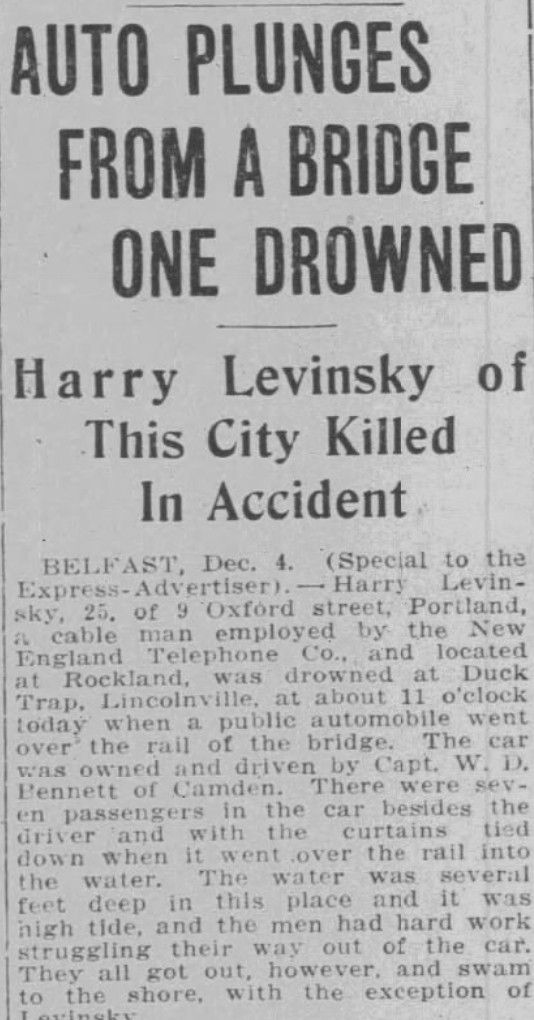
On Wednesday, Dec. 4, 1918, a public car carrying eight men from Belfast to Camden skidded on the Ducktrap Bridge in Lincolnville, broke through the wooden railing and dropped into the river. One of them, a 25-year-old telephone cable splicer from Portland, never made it out.
The state replaced the bridge. Then, in 1932, it built a second bridge right on top of the new one, an arrangement the federal engineering survey of the bridge later called unique in Maine. It stood until 1999.
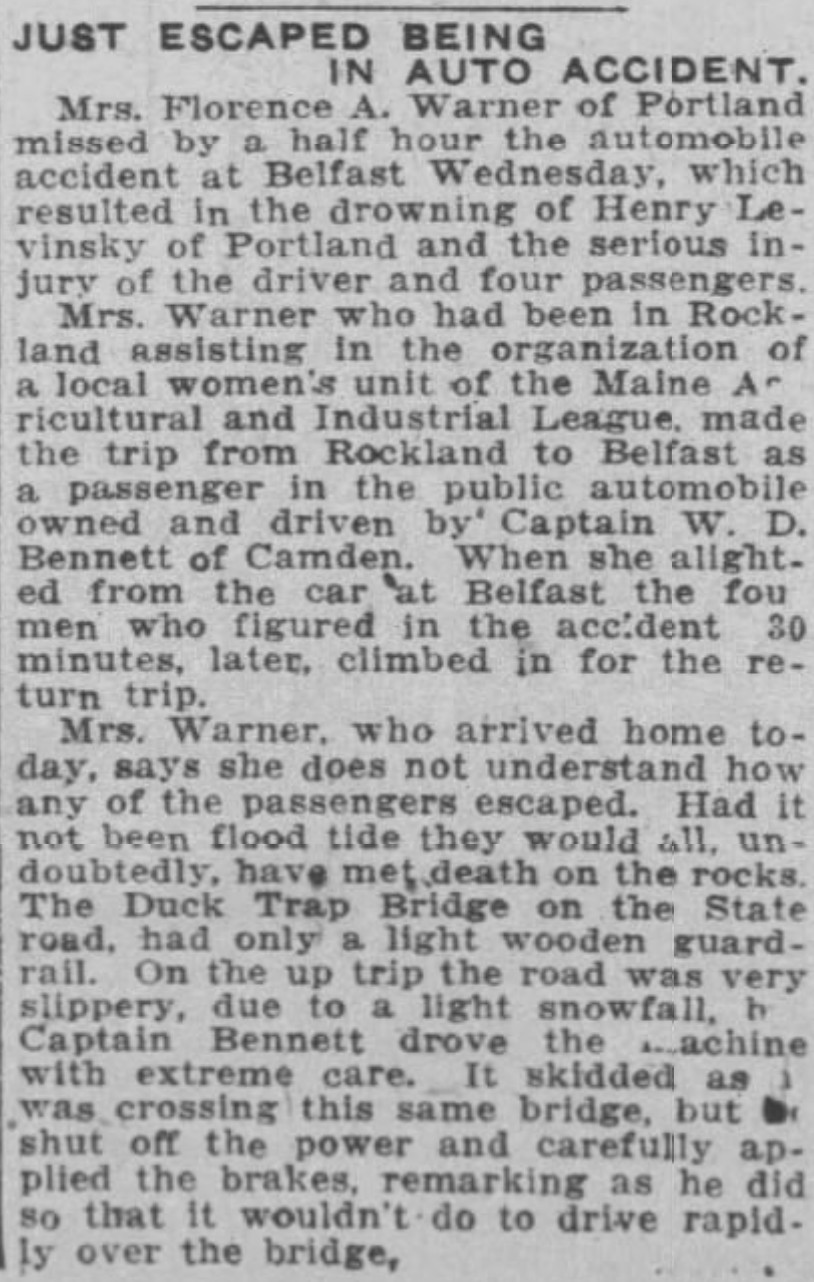
Here’s how Belfast’s Republican Journal reported it the next day (the papers of the day spelled it Duck Trap):
A frightful auto accident happened at Duck Trap bridge, Lincolnville, Wednesday when the public car, owned and driven by Capt. W. H. Bennett on his down trip to Camden, skidded and striking the railing went over into the water with its eight occupants.
A public car was an automobile that carried paying passengers. Bennett ran his between Belfast and Camden.
Eight men in a Thomas
The car belonged to Capt. Bennett of Camden, who drove it as a public car between Belfast and Camden. It was a Thomas, and that day its side curtains were tied down.
His passengers were a mixed crowd. On the back seat sat Eugene Spear, the New England Telephone Company’s manager in Belfast, his cable man Harry Levinsky, and C. S. Dennett of Bangor, a traveling salesman.
Two men from the state fish and game department sat on an improvised center seat. They were Commissioner Willis E. Parsons of Foxcroft and Frank M. Perkins of Bradley, the chief game warden, and next to them was Ralph P. Brown of Old Town. D. E. Clancy, a salesman for Stickney & Poor, rode up front with Bennett.
Bennett was nervous about this crossing. The Republican Journal said he had “dreaded the Duck Trap” all the way down from Belfast and kept mentioning it, and that he had chains on and was driving very carefully.
He had reason to worry. A Portland woman, Mrs. Florence A. Warner, had ridden the same car up from Rockland to Belfast that morning. The road was slick with a light snowfall, and the car skidded on that very bridge. Bennett shut off the power, applied the brakes carefully and remarked that it wouldn’t do to drive fast over the bridge.
Mrs. Warner got out at Belfast, and the men boarded for the return trip. About half an hour later, the car went into the river.
Into the Ducktrap
The Evening Express put the crash at about 11 o’clock that morning. According to the Republican Journal, as the car started across, it began to swerve toward the bay side and slammed into the railing. It went over, “turning turtle,” and landed upside down in the stream about 30 feet below.
It was high tide. The Express described what happened next:
There were seven passengers in the car besides the driver and with the curtains tied down when it went over the rail into the water. The water was several feet deep in this place and it was high tide, and the men had hard work struggling their way out of the car.
Spear later said none of them knew how they got out. Warden Perkins told the Bangor Daily Commercial that he saw the young cable man go under:
Warden Perkins saw Levinsky as he was going down after having cleared himself from the car, but he was unable to reach him.
Perkins swam about 150 feet to shore, breaking ice part of the way. Spear reached the bridge abutment, pulled off his heavy overcoat, climbed up to the road and went straight to Fred Amborn’s house to telephone for help. He said he was in the water about twenty minutes and kept falling on the way to the house.

Help was close behind. C. W. Shorey of Waldo was driving right behind them in his own car, and he helped pull men out as they reached the bank.
Then the Rockland public car came along, driven by James Randel of Belfast. Randel and his assistant got ropes and ladders and hauled the men up to the bridge. The Republican Journal thought that without them “other lives would have been lost.”
Commissioner Parsons, the man in charge of Maine’s fish and game, had to be hoisted up to the bridge with a rope around his body. According to the Bangor Daily Commercial, Parsons had two broken ribs. Bennett hurt his lungs, and on Dec. 12 the Republican Journal said he was still suffering and greatly depressed.
Levinsky’s body was recovered a few hours later. It was lying at the Amborn store when an assistant from the Belfast undertaker arrived at 4 p.m. to take it back to town.
Who was Harry Levinsky?
The records fill in a little more about Harry Levinsky. He was born in Portland on July 4, 1893. The 1910 census found him at home in Portland’s Ward 1 with his father Philip and mother Sarah, both born in Russia, and seven brothers and sisters, all born in Maine.
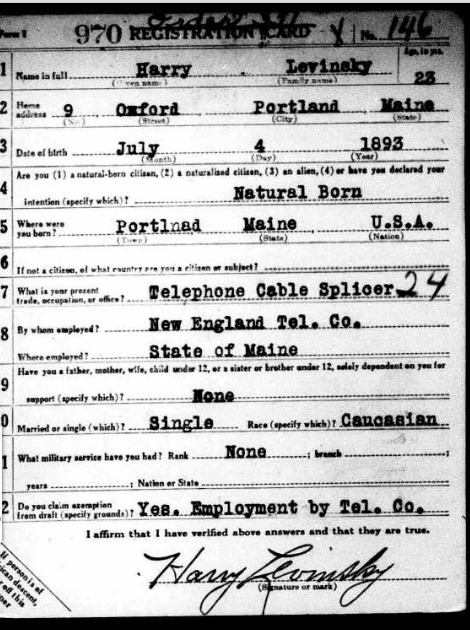
When he registered for the draft in Portland on June 5, 1917, he gave his address as 9 Oxford Street and his job as telephone cable splicer for the New England Tel. Co., working around the State of Maine. He was single, and he claimed an exemption because of his telephone work.
The Republican Journal said he was in Belfast often on business and well known and liked there. On that trip he was coming back from Bangor, where he had just passed his examination as a first-class cableman, and the paper said he was “very happy over his promotion.” He still lived with his parents.
Then there’s this detail, which is hard to read without wincing. Levinsky had thought about riding with a Mr. Webb instead. According to the Republican Journal, he said he “didn’t like a Ford” and took his seat in Bennett’s car.
His death record lists the cause as drowning in an automobile accident at the Duck Trap bridge. He was buried in Portland on Dec. 6, 1918.
A light wooden guardrail
The bridge Levinsky died on was the latest in a long line. According to the engineering survey’s history, the first record of a bridge here is 1802. That year George Ulmer got a charter for a toll bridge over the Ducktrap, and a sturdier timber bridge followed in 1821. (Ducktrap also turns up in the story of Lincolnville’s Noah Miller.)
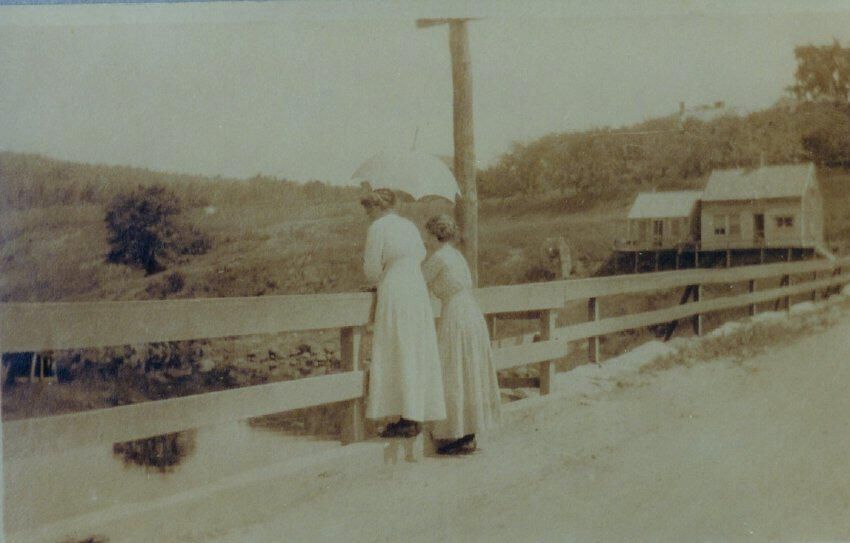
In 1908 the crossing got a new bridge of steel girders and a wood deck on rough split-stone abutments, with a wooden railing.
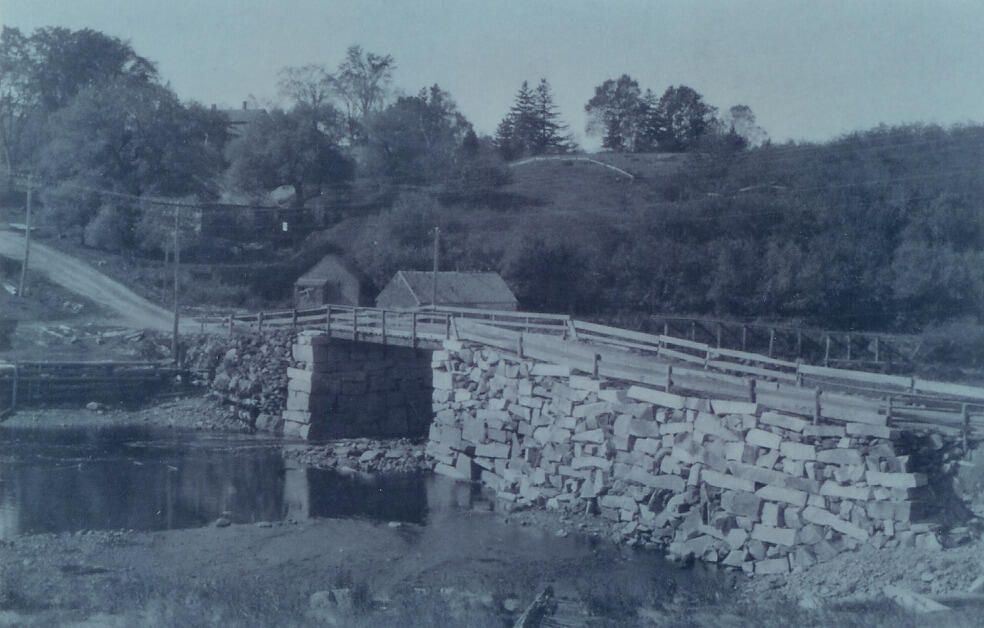
Mrs. Warner, who had crossed it that morning, didn’t think much of it:
Had it not been flood tide they would all, undoubtedly, have met death on the rocks. The Duck Trap Bridge on the State road, had only a light wooden guardrail.
The bridge wasn’t in good shape, either. The Historic American Engineering Record cites a state highway report saying spring floods had pushed one abutment out of place. After the crash, the decision was made to build a new bridge.
A concrete bridge, 1919
By June 1919 the State Highway Commission was advertising for bids on a list of new reinforced concrete bridges, and the Duck Trap Bridge was first on it. Bids were due July 5, 1919.
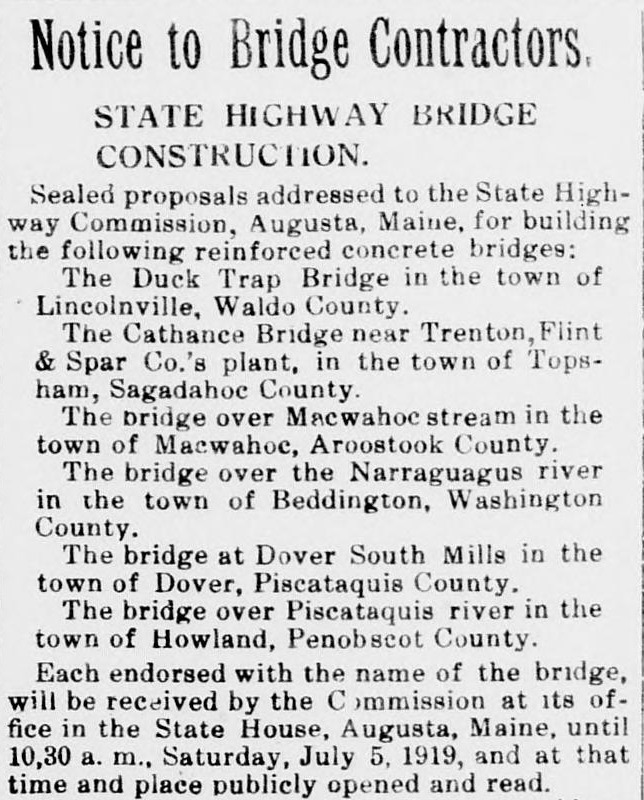
Cyr Brothers of Waterville won the job at $18,840. Work started on July 25, 1919, and dragged on until Oct. 1, 1920. The final bill came to $19,132 for the contractor plus $1,241 for engineering and inspection. The state paid half, Waldo County 30 percent and the town 20 percent.
What Lincolnville got was a plain concrete span, 58 feet long, on granite-faced abutments, with concrete railings instead of wooden ones.
A bridge on top of a bridge
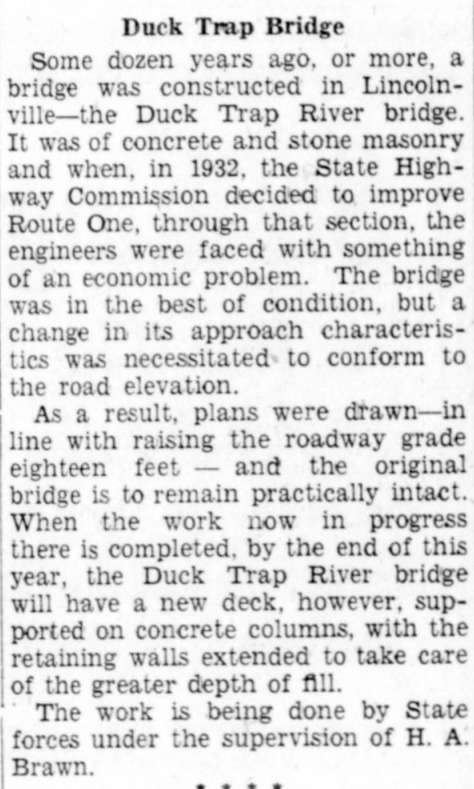
In 1932 the state rebuilt Route 1 through Lincolnville, and it wanted to get rid of the steep grade down to the river. The plan was to raise the road about eighteen feet.
The catch was that the bridge was only about a dozen years old. The Courier-Gazette in Rockland explained the thinking:
The bridge was in the best of condition, but a change in its approach characteristics was necessitated to conform to the road elevation.
So rather than tear it down, they left “the original bridge” in place and built a new one on top of it, on concrete columns standing on the old deck. State crews did the work, men hired by the day, for $38,283 in labor and materials. Nobody seems to have recorded who designed it.
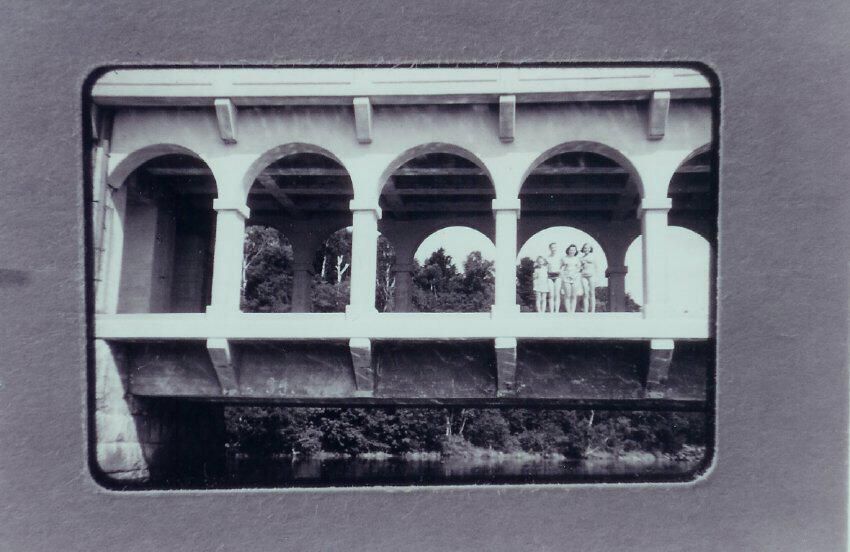
The upper bridge had three spans, 60 feet in the middle and 27 feet at each end, and the row of round arches along each side was purely decorative. The Historic American Engineering Record said the upper tier “suggests the appearance of a Roman aqueduct,” and called the two-story arrangement unique in Maine.
It opened to traffic on Nov. 23, 1932, with temporary railings; the concrete railings came the next spring. A few days before it opened, the Courier-Gazette had already made up its mind: “It is a revelation to the traveling public.”
In August 1997, with the bridge scheduled to be replaced, the Historic American Engineering Record sent photographer Brian Vanden Brink to document it. A Lincolnville Historical Society photograph shows the new bridge going up in 1998. The two-tier bridge was demolished in 1999.
One of Vanden Brink’s photographs was taken from the old deck, under the arches. Standing there, you were on the bridge that replaced the one Levinsky went off, looking down the Ducktrap toward the bay.

Liked this one? Get more tomorrow.
Lost Maine stories in your inbox most mornings: the newest, plus a few from the archive.
 A Nazi General, Two Dead Japanese Officers and the U-Boat Brought to Kittery
 The Brady Gang: How Public Enemy No. 1 Died on a Bangor Street in 1937
Free. Unsubscribe anytime.
AI helped research and write this story. Here’s how we use AI.Suggest a correction