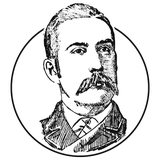


At half a minute before noon on November 20th, 1885, a sheriff pressed his foot on a spring in the yard of the Maine State Prison in Thomaston. The trap fell. Daniel Wilkinson dropped seven feet.
Nobody has been executed in Maine since.
Wilkinson was an English sailor and burglar who had shot a Bath constable in the face two years earlier. He went to the gallows angry, unrepentant and convinced that Maine only hanged foreigners. Sixteen months later, the Legislature abolished the death penalty for good.
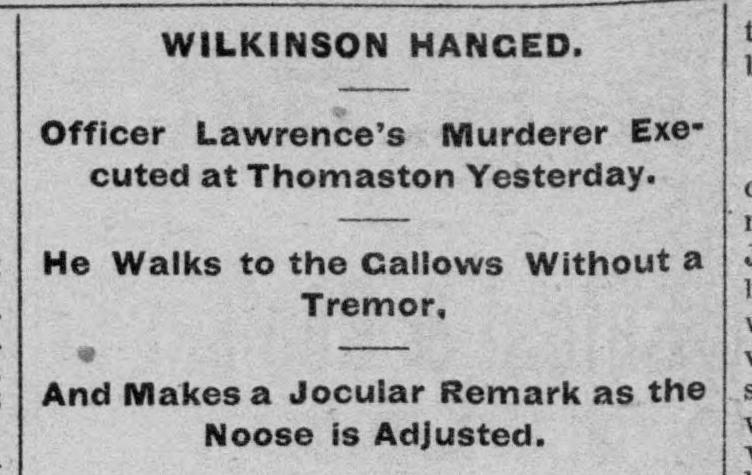
The night on Front Street
The crime happened just after midnight, on the night of September 3rd, 1883, in downtown Bath.
Wilkinson and a fellow Englishman named John Elliott were trying to force the door of D. C. Gould’s store. Officer Kingsley heard them and blew his alarm whistle. The two men dropped their tools and ran, and Kingsley fired after them.
Constable William Lawrence heard the whistle and came running. The Republican Journal in Belfast described what happened next:
On the corner of Front street Lawrence met a running man, who proved to be Wilkinson and stopped him by throwing both arms about him. Wilkinson had a cocked revolver in his hand and placing it at Mr. Lawrence’s head fired, the bullet lodging at the base of the brain.
The Portland Daily Press added that the muzzle was so close the flash scorched Lawrence’s cheek. The policeman fell dead, the Republican Journal wrote, and Wilkinson ran.
Lawrence was known around Bath as “Uncle Billy.” According to the Daily Kennebec Journal, he had spent years at sea before that as first officer of a ship.
Elliott got away too. He was last seen in Portland two days later, and was never heard from again. I’d love to know what happened to him.
Caught in Bangor
Bath police found a burglar’s chisel by Gould’s door. It matched marks on a Brunswick store that burglars had tried a few days earlier. That trail led to a Portland boarding house where a stranger had registered as John Elliott and skipped out on his bill.
Elliott had a companion, and you can probably guess who it was … Daniel Wilkinson.
Officers traced Wilkinson to Bangor, where he was working for a lumbering firm. They arrested him about two weeks after the murder, with a revolver and burglar’s fuse in his things. The Republican Journal reported that he was frightened and confessed to shooting the officer.
He was convicted and, “after some delay,” sentenced to death on August 27th, 1884. He went to the state prison at Thomaston to wait.
Who was Daniel Wilkinson?
Nobody was ever quite sure. After the hanging, the Republican Journal said everyone believed Wilkinson was not his real name, and that his true identity would probably never be known.
He said he was born near London, the son of a small tradesman. He also said he ran away to sea at 14 against his parents’ wishes (that’s his story, anyway). He was about 39 when he died.
He was no stranger to Thomaston. According to the Portland Daily Press, he had been sent to the Maine State Prison for burglary in 1866 and finished that sentence in 1872. Around 1880 he was arrested for a burglary in Woolwich and broke out of the jail in Bath.

He blamed Maine for all of it. His first prison term, he said, was for burglaries his employer had committed. That had turned him bitter toward the people of Maine and “hardened him to a life of crime,” the Republican Journal wrote.
The Thomaston gallows
Wilkinson was not the only man waiting on the gallows in Thomaston that year.
Maine had abolished the death penalty in 1876, then brought it back for first-degree murder in 1883. The first two men hanged under the restored law were Carmine Santore and Raffaele Capone, Italian railroad laborers convicted of killing and robbing Paschual Coscia in Brewer. They died together in the prison yard on April 17th, 1885.
In a dispatch from Thomaston the day before, the Daily Kennebec Journal described the scaffold. It was built under a platform between two of the prison workshops, on the edge of an old quarry. From there, the reporter wrote, the condemned men could look up at the gray prison walls and down into the deep quarry pond below the scaffold.

The gallows itself was new. The beam it hung from was not.
The gibbet is entirely new except the hanging beam, which is made of Norway pine and thus withstood the rot. This beam has quite a history. It was bought of the United States government in 1865, to hang Spencer, the convict who murdered Waden Tinker. Before hanging Spencer, it had hung Cox and Williams, the pirates, at Auburn.
That’s one well-traveled beam. Since Spencer, the paper went on, three more men had swung from it at Thomaston (two of them were Louis Wagner and John True Gordon).

Wagner murdered two women on Smutty Nose Island in the Isles of Shoals in 1873. Gordon killed his brother’s family with an axe in Thorndike. They were hanged together at Thomaston on June 25th, 1875.
That morning Gordon stabbed himself in the chest with an old shoe knife. He was hanged anyway. In 1876, Maine abolished the death penalty.
“The only two friends I have”
By the fall of 1885 Wilkinson had his own date. On November 5th, the Governor and Council heard his lawyer’s plea for a commutation. They voted to take no action.
Wilkinson took that as proof of what he’d been saying all along. The day before the hanging, he told a reporter that only foreigners and Black men were ever hanged in Maine, and that a native-born man would have gotten life.
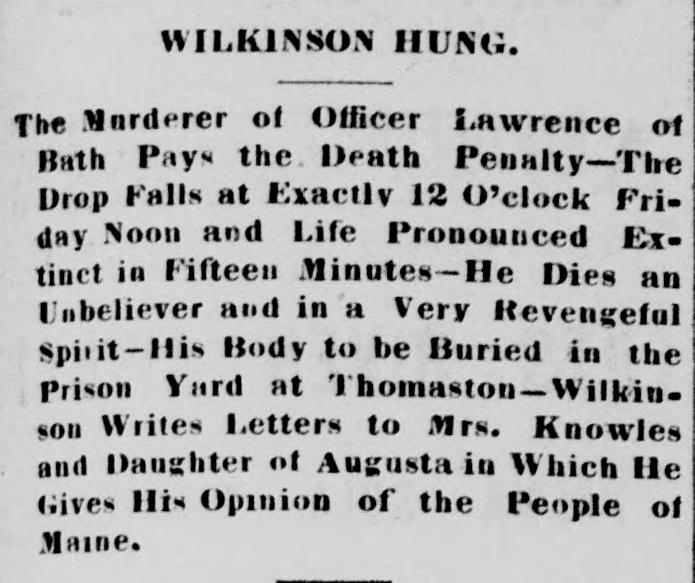
He did have one friend. Mrs. Belle Knowles of Augusta had met him in the Augusta jail, where she visited prisoners, and they had been writing to each other. In his last letter to her, he wrote that her family did not seem to him like a Maine family at all.
In his experience, he said, when Maine people saw a foreigner under a cloud, they did all they could to keep him under.
He told the prison chaplain, Rev. Frederick Towers, that he had planned to kill himself in his cell rather than hang. A letter from Mrs. Knowles the day before talked him out of it.
The last morning
Wilkinson slept well his last night and ate everything they gave him for breakfast. Then, a few minutes before 11 o’clock, a pale woman holding a little girl’s hand walked into the prison.
It was Mrs. Knowles. Her family had told her the hanging was postponed, and she had rushed down from Augusta when she learned it wasn’t. The Portland Daily Press reported their meeting at his cell:
“I come in the name of Christ,” said Mrs. Knowles. “I am glad to see you,” said the prisoner, in a low tone; “you and your daughter are the only two friends I have on this side of the water.”
He gave them a prayer book with their names written in it. When she came back up the stone steps to the guard room, she nearly fainted.
At a quarter to noon, the procession crossed the prison yard and passed through the carriage shop to the scaffold. It was the same one that had hanged the two Italians in April. About 30 people watched.
While a deputy tied his feet, Wilkinson turned to the officers around him. “This is the way you murder men for fifty dollars a head, isn’t it?” he said, according to the Portland Daily Press.
Chaplain Towers read the service. Asked if he had anything to say, Wilkinson answered, “No sir.” I guess he had already said what he wanted to say.
The black cap came down. Sheriff Irish took off his hat and, by the authority of the law, pronounced the sentence of hanging, the Republican Journal reported. He ended with “dead, dead, dead. And may God have mercy on your soul.”
The knot slipped forward of his ear. To an untrained eye, the Republican Journal wrote, it looked as though he had strangled to death.
After 17 minutes the doctors pronounced him dead. At his own request, he was buried in the prison yard.
Maine abolishes the death penalty, 1887
Wilkinson’s lawyer had pointed out that he wasn’t the only one convicted of first-degree murder since 1883. Mrs. Barrows and her son-in-law, Oscar Blaney, had been convicted of murdering her husband in Kittery. When Wilkinson died, both of their pleas for commutation were still pending before the Governor and Council.
A month later, the Springfield Republican reported that Blaney’s sentence had been commuted. Mrs. Barrows’ case had been put off until April 1887, so that the next Legislature could consider her death sentence.
And the next Legislature? It didn’t wait for April.
On the morning of March 15th, 1887, Representative Engel of Bangor gave the only speech on the bill in the Maine House.
In the seven years without a death penalty, he said, Maine had 24 murders. In the four years since it came back, it had 37. “Let us,” he concluded, “repeal this obnoxious law, and rise one step in civilization.”
The House voted 87 to 21 against killing the bill. The governor approved “An Act to abolish the Death Penalty” on March 17th, 1887. The sentence for first-degree murder became life at hard labor.
Mrs. Barrows was never hanged. Lawmakers have tried to bring the death penalty back many times since, most recently in 2005, according to the Bangor Daily News. None of the bills became law.
What’s there now
The prison where Wilkinson died stood in Thomaston for 178 years, from 1824 to 2002. A fire in 1923 destroyed most of its buildings, and the state rebuilt it in 1924.
In February 2002 guards moved the prisoners by bus, over several nights, to a new Maine State Prison in Warren. By early summer the old prison was gone. According to the historical marker on the site, its rubble was pushed into the old quarry and covered with dirt.
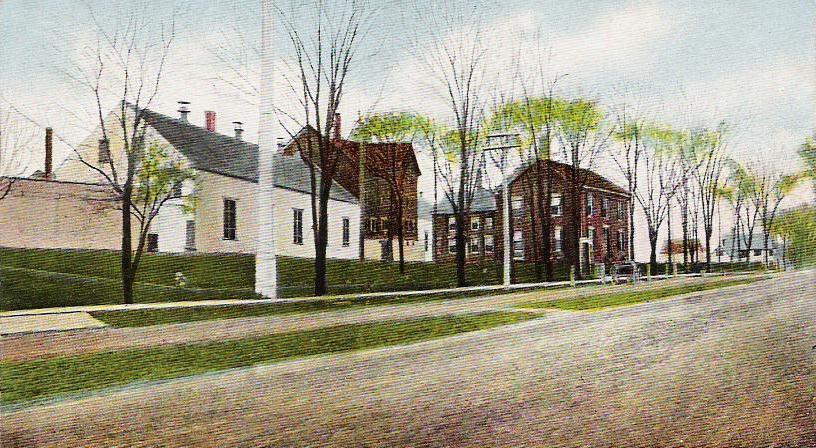
If you drive through Thomaston today, you’ll find a town-owned green along Main Street. One corner of the prison wall was left standing to mark the spot.

In Bath, a marker on Broad Street near Front Street remembers Constable William Lawrence, who was shot and killed there by a burglar while on patrol on the night of September 3, 1883.
Wilkinson wasn’t the only burglar from those years to land in Thomaston. Read about the Portland thief, sentenced to 20 years there in 1893, who sent a poem to the officer who shot him.
Lost Maine stories, in your inbox.
The newest story, plus a few from the archive.
Free. Unsubscribe anytime.
We use AI to help research, write and edit stories across our sites. Here’s how we use AI.Suggest a correction