
Think about a bulldozer. Or a snowcat, or an Army tank. They all roll on the same idea: a continuous loop of track that lays its own road as it goes.
One of the first machines to make that idea actually work for a living was built in Waterville, Maine.
Seriously. Waterville!
The inventor was Alvin O. Lombard, and the machine was a steam log hauler. In 1900 he gave it a trial run on a railroad siding in town. A year later, a Bangor reporter wrote that the demonstration “made the natives’ eyes stick out.”
Who was Alvin Lombard?
Lombard was born in Springfield, Maine, in 1856. He moved to Waterville in 1895.
He’d been tinkering his whole life. According to his house’s 1981 National Register nomination, as a boy he built a model sawmill that sawed cucumbers, and a water wheel that helped churn butter.
As a grown-up, his inventions were more practical. He’s credited with a governor for water turbines, a bark stripper, a knot separator, a pulp crusher, and even a steam-driven automobile. By 1902, the New-York Tribune was calling him “a mechanical genius” who had made a fortune from his inventions.

But Lombard’s big idea came out of the Maine woods.
Why Maine needed a log hauler
Every winter, Maine’s lumber camps hauled logs out of the woods on sleds over iced roads, and horses did the pulling. It was brutal work for the animals. The plaque the American Society of Mechanical Engineers later put on a Lombard says the machine “emancipated horses from the killing work.”
Steam was the obvious answer. The problem was traction.
The Tribune explained that a Maine man had tried a steam log hauler about fifty years earlier, on big spiked wheels. Hitched to a load, the wheels just spun “like those of a locomotive on a wet rail” and dug the machine into holes in the snow.
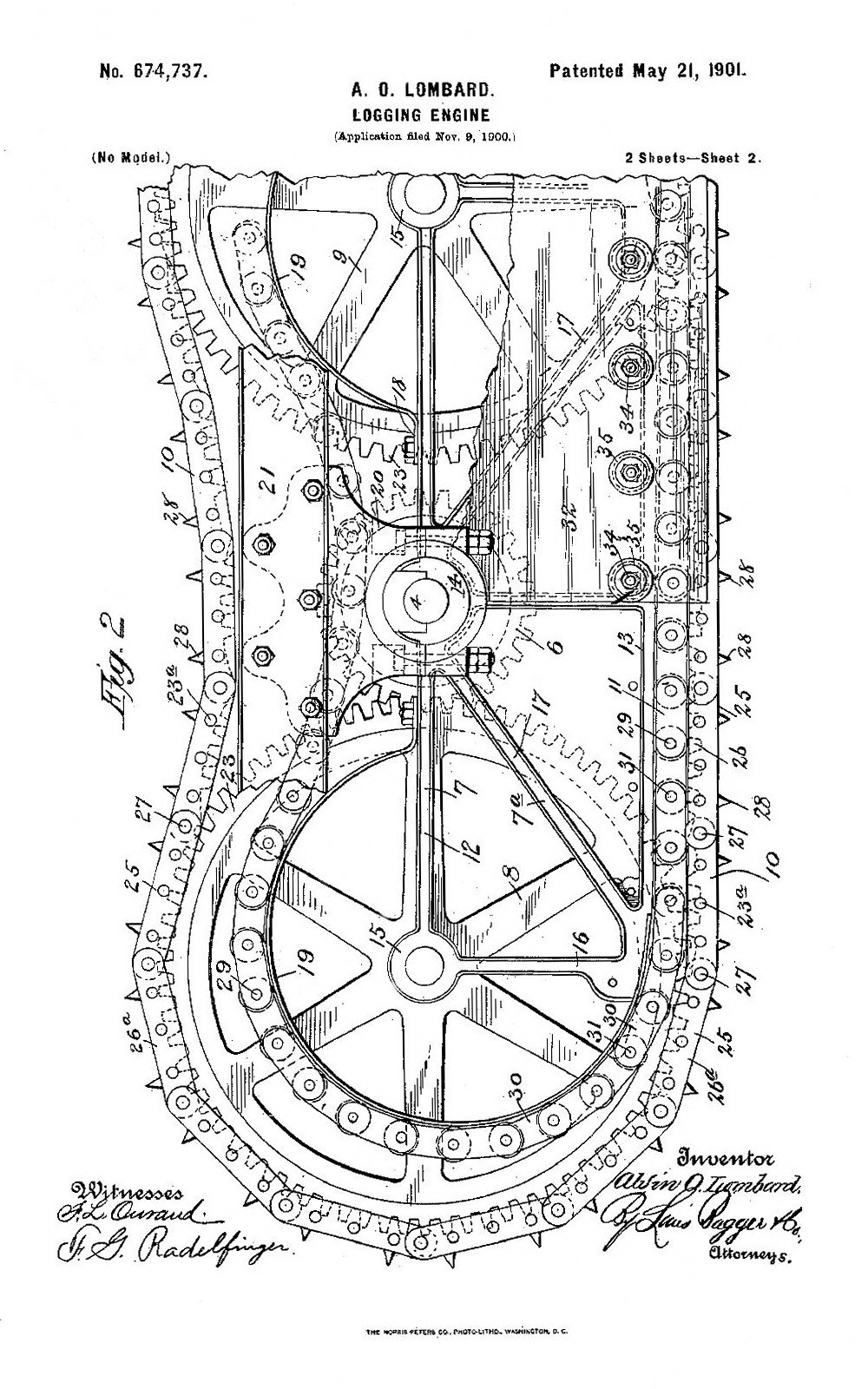
Lombard’s fix was the key. Instead of wheels, he gave his machine what the Tribune called “a sort of self-laying rail,” a chain of metal plates, or lags, that wrapped around the drive wheels. The weight spread out over the snow, and the lags gripped.
He filed for a patent on November 9th, 1900. Patent No. 674,737, for a “Logging-Engine,” was issued on May 21st, 1901.
The trial run in Waterville
The first machine ran on Thanksgiving Day, 1900, according to the American Society of Mechanical Engineers. Before it ever saw the woods, Lombard tested it right in Waterville.
A Bangor dispatch printed in the Buffalo Review on October 10th, 1901, told the story:
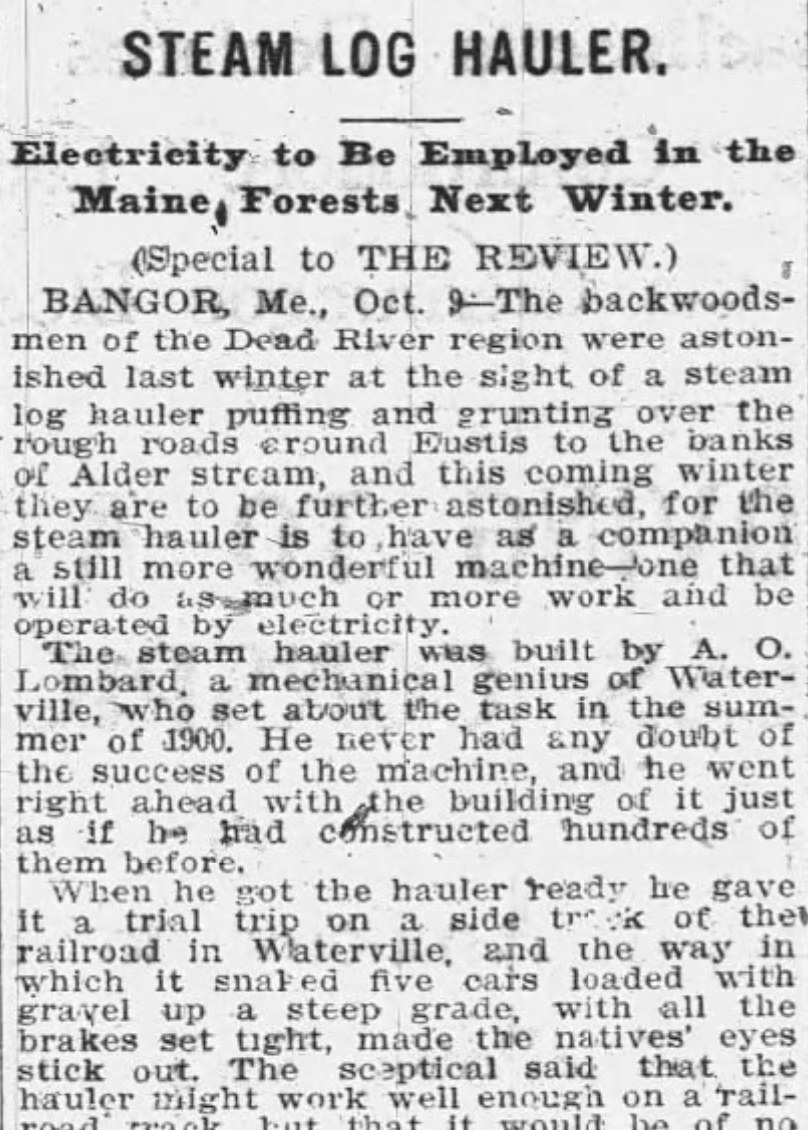
“When he got the hauler ready he gave it a trial trip on a side track of the railroad in Waterville, and the way in which it snaked five cars loaded with gravel up a steep grade, with all the brakes set tight, made the natives’ eyes stick out.”
Not everyone was sold. The skeptics said it might work on a railroad track but would be no earthly use in the woods.
So Lombard sent it to the woods. It went up to Eustis in the Dead River country, partly by rail and then across lots on its own.
“The old-timers were dazed”
Here’s what happened when it got to the logging camps on Alder Stream:
“At first the old woodsmen laughed at it, but when it was found that it could haul four or five sled-loads of logs with ease, traveling just as fast over knolls as on the level, and turning out without any fuss to allow teams to pass in the narrow road, the old-timers were dazed.”
On a seven-mile haul to the landing, the paper said, it made two trips a day all winter, with 30,000 feet of logs a trip. When deep snow stopped the horses, the crew hooked the hauler to an 18-foot plow and it “scattered the drifts like chaff.”
How cool is that?
Horses up front, steering
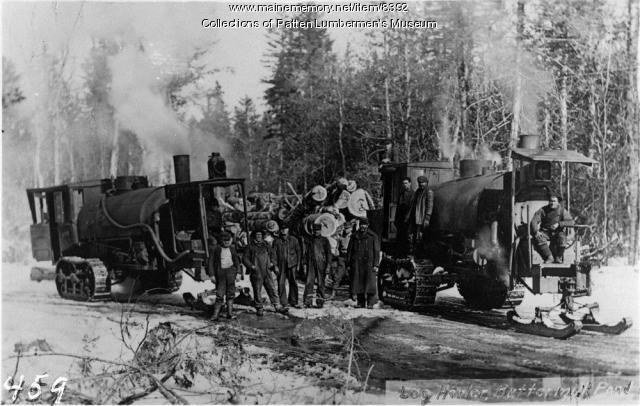
Now for the funniest detail. The early Lombards couldn’t steer themselves very well. So the front end rode on a sled with a long pole sticking out, and a team of horses was hitched to it.
The New-York Tribune of June 17th, 1902, explained:
“The forward end of the hauler is carried by a sled, to which is attached a pole. A pair of horses is hitched to this pole and driven ahead to guide the machine, but the horses do no hauling.”
So the horses got a promotion. They went from pulling the load to just pointing the way.
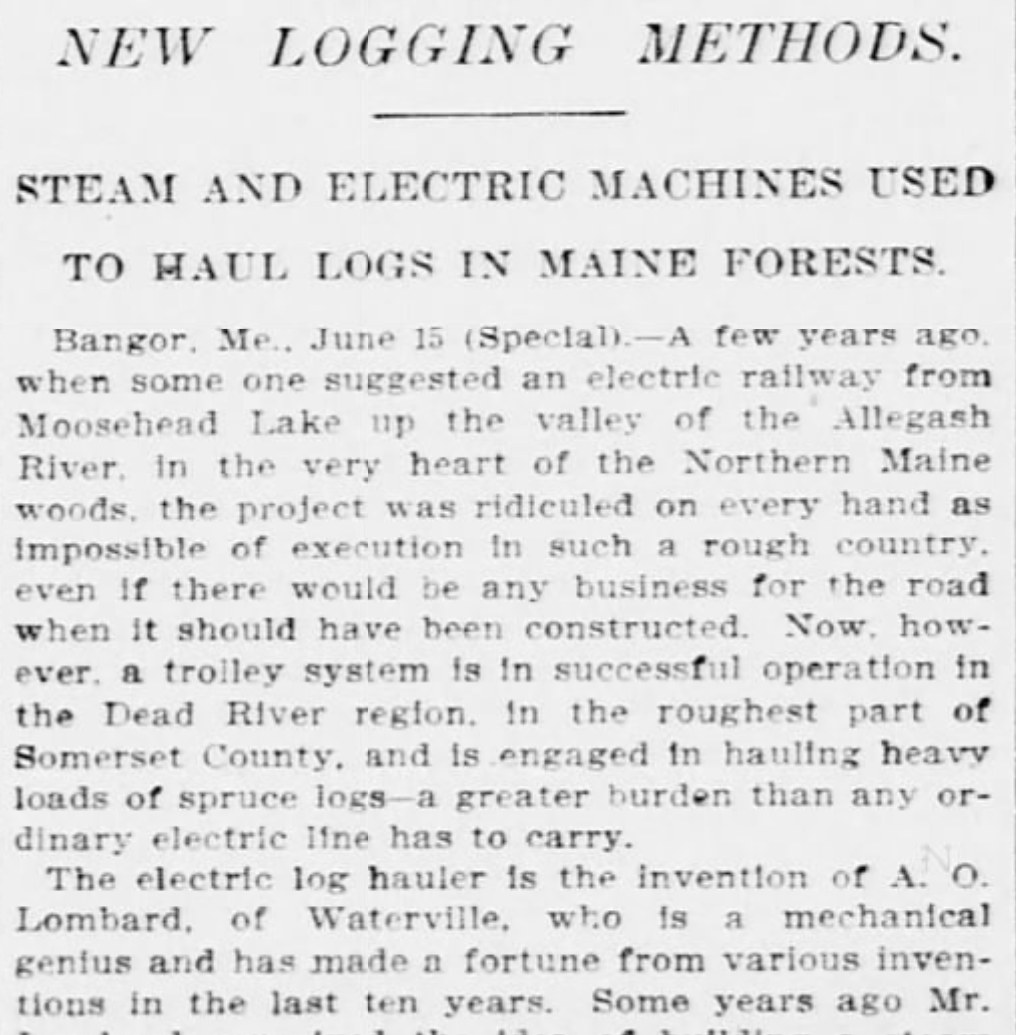
The Tribune said the hauler was doing the work of thirty horses. And while horses were expensive to keep and feed, the steam hauler “eats nothing but a few cords of wood.”
Lombard even tried an electric version, running off a trolley wire strung through the trees along Alder Stream, with power from a new station at a waterfall. (A trolley line in the Maine woods!) It did haul logs for about three miles. Then came the first wet snow of the fall. According to a 1967 history by Lore A. Rogers and Caleb W. Scribner, short circuits knocked it out of commission, and the project was dropped.
The Waterville factory
Lombard built his haulers at home. The first ones came out of the Waterville Iron Works. Then the Lombard company set up its own shop on College Avenue, south of what became the Keyes Fibre mill (Huhtamaki today).
You can see it on the 1911 Sanborn fire insurance map of Waterville. It’s drawn as an inset because it sat two miles north of City Hall, out by the Maine Central tracks.

Look at the labels. Machine shop, forge room, woodworking machines, a casting store, and a long brick building just for storing finished haulers.
According to ASME, the company built 83 steam log haulers. Most went to Maine and New Hampshire. Three went to Russia, and one went to Montana.
Big lumber outfits bought them, including Great Northern Paper and the Eastern Manufacturing Company. And Lombard sold the rights too. In 1904 the Phoenix Manufacturing Company of Eau Claire, Wisconsin, bought a hauler and a license to build its own. Phoenix later sold a version it called the Centiped.

What about Caterpillar?
Here’s where the story gets a little spicy.
Out in California, Benjamin Holt was building tracked tractors too. In 1925 his company merged with C. L. Best’s to form Caterpillar. Holt is often credited with the crawler tractor.
But a 1967 history of the log haulers by Rogers and Scribner, later reprinted by ASME, cites a Lombard company memo about a meeting with Holt on February 21st, 1910, in California. According to the memo, Holt admitted he was infringing Lombard’s patent and agreed to pay a royalty.
It never happened:
“the agreement was never signed by Holt nor was any royalty ever paid Lombard by him or by his company.”
To be fair, Lombard didn’t invent the idea of a track from scratch. The same history notes an 1859 patent for a similar system by Warren P. Miller. What Lombard did was make one that worked, day after day, in the deep snow of the Maine woods. The ASME plaque calls the Lombards the first practical examples of the often-tried crawler tread.
Gas, diesel, and the end of the line
Lombard kept going after steam. He built gasoline haulers starting around 1908 and 1909, and later tractor trucks.

By the mid-1920s, gasoline trucks had made the steam haulers obsolete. According to the Maine Forest & Logging Museum, the last Lombard of all was a 1936 diesel. Alvin Lombard died in 1937.
The museum says many of the old steam haulers were recycled for scrap iron during World War II. According to the Morning Sentinel in 2020, only six of the 83 are known to survive, and three of them still run.

That’s No. 38. The Waterville company finished it in December 1907 and sold it to the Eastern Manufacturing Company. It hauled logs to Chamberlain Lake, was abandoned in the woods, was pulled back into service, and was finally left at Knowles Brook in 1925. It sat there for more than forty years.
Today it steams again at the Maine Forest & Logging Museum in Bradley.
If you want to see more of the work behind Maine’s old industries, there are the granite cutters of Hurricane Island and the millworkers’ neighborhood of Little Canada in Lewiston.
Where to see a Lombard in Waterville today
Here’s the best part. There’s a Lombard in Waterville right now.
It’s a later Lombard, marked about 1926 on its plaque. Back in the 1970s, Waterville’s code enforcement officer, Fred Prescott, and a pilot named Kenneth Ireland spotted it from the air in the woods near Churchill Dam, on a fishing trip. The Breton family of Vassalboro restored it.
In 1981 it went on display on Front Street, near the Ticonic bridge, with a small plaque dedicated on December 2nd of that year. In 2020 the city moved it to the grounds of the Waterville Historical Society’s Redington Museum on Silver Street.
And Lombard’s own house is still standing on Elm Street, across Appleton Street from the public library. He built it in 1908. It’s on the National Register of Historic Places.

So the next time you watch a bulldozer crawl across a job site, think of a Waterville machine shop, five gravel cars on a railroad siding, and a team of horses out front, steering a steam engine through the snow.
Lost Maine stories, in your inbox.
The newest story, plus a few from the archive.
Free. Unsubscribe anytime.
We use AI to help research, write and edit stories across our sites. Here’s how we use AI.Suggest a correction