

Here’s a Revolutionary War story most Mainers have never heard. In 1776 a small band of rebels set out from Machias to take a British fort in Nova Scotia. By the time they headed up the Bay of Fundy, they were 72 men in whaleboats and canoes.
By their leader’s own account, they tried to storm Fort Cumberland with scaling ladders on the night of Nov. 12, 1776.
It didn’t go well (you probably guessed that). But the man who led it ended up on the Penobscot. The town that grew up on the land he and his comrades were granted carries his name: Eddington, above Bangor.
Who was Jonathan Eddy?
Jonathan Eddy was born about 1726 in Norton, Massachusetts. He first saw the Chignecto isthmus as a soldier, fighting the French at Fort Beausejour in 1755. He served there again in 1759 and 1760, after the British had renamed it Fort Cumberland. (The site is in New Brunswick today.)
About 1763 he settled on land the Acadians had been deported from in 1755. He became a county officer and served in the Nova Scotia House of Assembly.
So how did a Nova Scotia county officer end up attacking his own province? Remember, he was born in Massachusetts and came north as one of the New England settlers on the old Acadian lands. When the Revolution came, he sided with the Americans. The Dictionary of Canadian Biography says he and 14 associates left Chignecto in February 1776 to ask George Washington for help.
On March 27, 1776, Washington passed their petition along to Congress but wouldn’t commit troops, and Congress turned Eddy down too. Massachusetts gave him provisions and ammunition, but no army. When his fellow Cumberland patriot John Allan met Eddy’s schooner in Machias Bay on Aug. 13, 1776, Allan tried to talk him out of the whole thing. Eddy didn’t listen.
Whaleboats and canoes
Eddy left Boston, chartered a small vessel at Newbury and took about three weeks to reach Machias. Col. Shaw helped him recruit Capt. West and about 20 men there, according to Eddy’s report.

He picked up a few more at Passamaquoddy, then went about 60 miles up the St. John River. There a captain, a lieutenant and 25 men from the settlements joined him, along with 16 Indigenous men, and his tally came to “Seventy two Men.”
The 16 Indigenous men came from the St. John River. They came with “the Governor Ambrose,” whom the Dictionary of Canadian Biography identifies as Ambroise Saint-Aubin, a Wolastoqey (Maliseet) leader.
They set off “in Whale Boats and Canoes” and reached Shepody in a few days. At Shepody they bagged Capt. Walker and, by Eddy’s count, 13 men whom Col. Gorham, the fort’s commander, had posted there to gather intelligence.
At Memramcook the Acadian French “Readily joined us, although they saw the Weakness of our Party.” Then Eddy marched 12 miles through the woods to Sackville, where the local committee was dismayed at how few men he had and that he had no artillery at all. They joined anyway, hoping Col. Shaw, the man who had helped him at Machias, would send reinforcements.

The sloop in the mud
Now for my favorite part of the whole story. Before Eddy even made camp, about 30 of his men went after a sloop lying on the flats below the fort. It was loaded with provisions for the garrison and guarded by a sergeant and 12 men. Here’s Eddy describing what happened next:
However, our men rushed Resolutely towards the Sloop up to their Knees in Mud, which made such a Noise as to alarm the Centry, who hailed them & immediately called the Sergt of the Guard: The Sergt. on comming up, Ordered his Men to fire, but was immediately told by Mr Row that if they fired one Gun, Every Man of them should be put to Death; which so frightened the poor Devils that they surrendered without firing a Shot, although our People Could not board her without the Assistance of the Conquered, who let down Ropes to our Men to get up by.
How crazy is that?
It gets better. All morning, more soldiers came down from the fort without knowing the sloop had been taken, and Eddy’s men captured them one party at a time. Among them were Capt. Barron, the garrison’s engineer, and Mr. Eagleson, whom Eddy says “may be truly Called the Pest of Society.”
When the garrison finally saw the sloop under way, it fired its cannon and sent about 60 men after it. By then the sloop was too far off for the shot to do any harm. A Boston news report later listed the cargo as beef, pork, flour, peas, candles, blankets, iron, steel and nails, all carried into Newburyport.
“I am determined to storme the Fort”
With the sloop taken, Eddy camped about a mile from the fort. Local recruits brought his force to about 180, but with guards and prisoners to handle, no more than 80 were left in camp.
On Nov. 10, 1776, he sent in a summons to surrender, signed “Commanding Officer of the United Forces,” and gave the commander four hours to answer. The threat was plain: “if you refuse I am determined to storme the Fort.”
Lt. Col. Joseph Gorham of the Royal Fencible Americans answered the same day. He called the rebels his “deluded Brother Subjects,” and then he wrote this:
Be assured Sir I shall never dishonour the Character of a Soldier by Surrendering my command to any Power except to that of my Sovereign from whence it originated.

So that was that. On the night of Nov. 12, Eddy’s men went at the walls with scaling ladders, but the fort was stronger than they expected because of recent repairs. After two hours under fire they pulled back, with only one Indigenous man wounded. By Eddy’s count about 80 attackers had faced 100 men inside.
Eddy insisted that “Never Men behaved better than ours” under the cannonade. He settled into a blockade, cutting the fort off from the countryside and waiting for reinforcements from the west. According to the Dictionary of Canadian Biography, a second attack on Nov. 22 failed too.
Meanwhile Halifax had noticed. On Nov. 17, 1776, the Nova Scotia Council put a £200 reward on Jonathan Eddy.
It offered £100 each for William Howe and Samuel Rogers, two rebels it said were “actually before the fort at Cumberland,” and £100 for John Allan, who had been “deeply concerned in exciting the said rebellion.” Yes, that’s the same John Allan who had tried to talk Eddy out of the whole thing.
Sunrise surprise
The reinforcements came, just not for Eddy. He wrote that a man-of-war from Halifax arrived in the bay on Nov. 27 with nearly 400 men. A letter written from Machias on Dec. 21, 1776, says the British hit his camp at sunrise on Nov. 29. Eddy’s own report dates the attack Nov. 30. Here’s how he described it:
about Sunrise furiously Rushed upon the Barracks where our Men were quartered, who had but just Time Enough to Escape out of the Houses and run into the Bushes
The British burned 12 houses and 12 barns, with most of his stores inside, and the Cumberland committee decided to retreat to the St. John River.

That letter, printed in a Portsmouth paper on Jan. 7, 1777, paints the aftermath. Friends of the cause, “even Women with their Children,” fled into the woods, while Eddy, his men and the committee headed for Machias by way of Maugerville. The troops burned and destroyed “as far as Bloody Bridge.”
Gorham offered protection to everyone who came in and laid down their arms, except four people the letter doesn’t name. The Dictionary of Canadian Biography says the amnesty specifically left out Eddy. Plenty refused and said they “would rather perish in the Woods.” One list printed by Frederic Kidder counts 59 Cumberland men who fled, 28 of whom had reached Boston.
Kidder, writing in 1867, said the soldiers’ conduct after the defeat “was very savage.” John Allan’s house was one of the first burned, and his family hid three days in the woods. A 49-man relief party set out from Machias in boats. Lt. David Prescott and seven of its men got as far as Shepody on Dec. 9, heard the news and turned back.
Boston thought he’d won
Here’s the kicker. A Boston report of Dec. 26, nearly four weeks after the rout, still had Eddy on top. The Freeman’s Journal in Portsmouth, New Hampshire, ran it on Dec. 31:
And, it is supposed that by this time, Capt. Eda, with the remainder of his men, is in possession of Fort Cumberland.

Capt. Eda! They couldn’t even get his name right. The same report said 34 of the prisoners had been jailed in Boston, including Capt. Barron and “the pious parson Eggleston.”
A few days later Eddy wrote to the Massachusetts Council and House from Maugerville. In that report, dated Jan. 5, 1777, he asked for 200 men to try again.
How Eddy got a town
Kidder’s verdict was blunt: Eddy “was rash and lacked the necessary judgment.” Fair enough … though Eddy wasn’t done with the war. In August 1777, less than nine months after the rout, the British attacked Machias itself, and Eddy was there to help defend the town.
In August 1784 Eddy moved his family to Township No. Ten, on the east side of the Penobscot River at the head of the tide. In June 1785 Massachusetts granted him and 19 fellow refugees from Nova Scotia 9,000 acres there. According to the 1882 History of Penobscot County, each man had to build a house on his lot within two years.
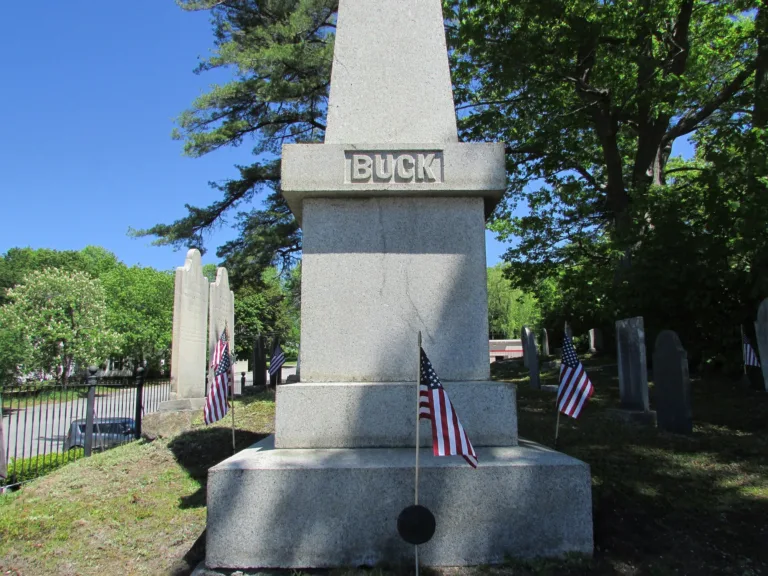
He died in August 1804, aged 78. Kidder put it simply: Eddy got a grant for himself and his comrades, “a township of land above Bangor, called after their old commander Eddington.” The 1882 county history says the town was incorporated on Feb. 22, 1811, and points out that it was Washington’s birthday. That’s the same Washington who wouldn’t give Eddy any troops.
Liked this one? Get more tomorrow.
Lost Maine stories in your inbox most mornings: the newest, plus a few from the archive.
 Why Was Bar Harbor Called Eden? The Town’s 1918 Name Change
 Matinicus Island: 14 Things You Didn’t Know About Maine’s Most Remote Island
Free. Unsubscribe anytime.
AI helped research and write this story. Here’s how we use AI.Suggest a correction