

In 1951, the Army Corps of Engineers began building a secret depot in the woods next to a new air base in Limestone, Maine. Locals say it was meant to look like a little village from the air.
One building was made to look like a two-story house, with fake windows and an upper floor no one could ever enter (pretty sneaky). And those grassy mounds nearby? They were concrete igloos, and inside them the Air Force kept atomic bombs.
The code name was Site Easy. The Historic American Engineering Record, which documented the base in the 1990s, calls it the first operational atomic-weapons storage site under Strategic Air Command control. And it sat beside one of the biggest bomber bases of the Cold War.
Why Limestone?
The answer was on a globe. Look at one from the top and you’ll see it: the Arctic offered a short route from northern Maine to targets in the European part of the Soviet Union.
Much of the chosen site was forest, marsh and bog. The planners wanted to avoid using productive potato land.
On May 22nd, 1947, Gen. Carl Spaatz, the commander of the Army Air Forces, flew in to see the site for himself. He landed at Presque Isle with barely an hour’s warning, then took a smaller plane up to look down on it.
The Bangor Daily News billed it as the future home of the most important bomber base on the Atlantic coast. On the same front page, Secretary of War Robert Patterson told Gov. Horace Hildreth that the base would cost about $28 million and be ready for operations around 1949.
It was being built for the six-engine B-36, a giant bomber designed for long-range missions. On May 23rd, 1947, the Army Corps of Engineers awarded the first construction contract to Lane Construction of Meriden, Connecticut, and T.W. Cunningham of Bangor.
Building in the frost
The builders had to fight the climate. An engineering magazine in 1949 described a site of long winters, deep frost, bog and forest.
To beat the frost, they laid the runway on a base 70 inches thick. The runway was later stretched to 12,100 feet.
Then came the Arch Hangar, finished in 1949. Its concrete roof spanned 340 feet without a single column, rose 90 feet at the top and was only 5 inches thick at the crown (yes, 5 inches). It and a twin in South Dakota were the largest arched concrete roofs in the country at the time.
Construction of a second giant, the Double Cantilever Hangar, began in 1954. At 250 by 600 feet, it could hold five B-36s at once.
Named for a Portland pilot
The 42nd Bomb Wing’s B-36s arrived in 1953, when the base began full operations. Limited operations had started in 1950.
On October 1st, 1954, Limestone Air Force Base got a new name. It honored Maj. Charles J. Loring Jr., a fighter pilot born in Portland in 1918.

Loring had been shot down and taken prisoner in World War II. On November 22nd, 1952, near Sniper Ridge in Korea, he was leading four F-80 jets against enemy gun positions when his plane was hit. Instead of turning for home, he deliberately dove his damaged jet into the guns.
His remains were never recovered. President Eisenhower presented his Medal of Honor to his widow at the White House in May 1954.
The bombs next door
This aerial photograph shows the base around 1970, with the runway down the middle and the separate weapons storage area in its own loop at the lower right.

Construction of Site Easy had begun back in 1951 and was completed in April 1952, with more storage igloos added afterward. By 1954, there were 47. The depot went through several official names, including Caribou Air Force Station, but veterans and local historian John Garbinski call it the North River Depot.
According to Garbinski, the depot sat behind four parallel fences, and the third one was electrified. David King, a former security policeman, said on a 2015 tour of the site that guards could neither confirm nor deny what was inside. At night, he said, the area was lit up like a baseball stadium (so much for blending in).
The barracks and dining hall were even connected underground, so no one had to go outside in a blizzard … or worse.
The B-52 years
On June 16th, 1956, Loring’s first permanent B-52 arrived. It was christened the State of Maine with a bottle holding water from both the Atlantic and the Pacific, because the new jet could fly from ocean to ocean without refueling.

From 1957 on, some of those bombers sat on alert around the clock, loaded and ready. Next to them the Air Force built a sunken crew building, begun in 1959 and finished in 1960, that crews called the Molehole. From alert pads like these, crews could get five bombers into the air in under three minutes.
The flying was dangerous. At a 2024 museum event, Maine aviation historian Peter Noddin recalled Loring’s fatal crashes in 1958, including a B-52 that went down on a farm in Limestone.
During the Cuban Missile Crisis in October 1962, Loring’s B-52s flew airborne alert missions while its tankers kept them fueled.
Intruders over the bomb depot
Loring’s most nerve-racking nights came in late October 1975. On the evening of October 27th, guards spotted what looked like a helicopter, with a red light and a white strobe, flying low near the base’s northern edge and the weapons storage area.
Radar picked up a second unknown craft circling to the northeast, and the first one headed off toward Grand Falls, New Brunswick. More sightings followed over the next several nights. The base went on high alert, and reports went all the way up to the National Military Command Center in Washington.
A military report, later released under the Freedom of Information Act, said the unknown helicopter had “demonstrated a clear intent in the weapons storage area.” It also called the pilot smart and very capable.
The identity of the aircraft remained unresolved in the accounts reviewed by The War Zone in 2020. Pretty eerie, right? That review cited a 1979 New York Times report that Air Force investigations had not found a cause for the sightings.
Closer to Moscow wasn’t enough
By the late 1980s the Cold War was ending, and the Pentagon needed fewer bases. On April 15th, 1991, Loring was on the Defense Secretary’s list of bases to close.
Maine fought back hard. The independent base-closing commission was weighing Loring against Plattsburgh Air Force Base in upstate New York, and its staff found almost no difference between the two.
On Sunday, June 30th, 1991, the commission voted 5 to 2 to close Loring. It spared Plattsburgh in that round of closures.

For Commissioner Duane Cassidy, a retired Air Force general, quality of life made the difference. Everyone he asked, he said, wanted to go to Plattsburgh, and nobody wanted to go to Loring.
“If you can’t get business to move up there, how can you ask a G.I. and his family to move up there and live …”
That one had to sting. Senators George Mitchell and William Cohen, Representative Olympia Snowe, Governor John McKernan and a long list of Aroostook towns sued. They lost in federal court in 1992 and again on appeal in 1993.
The last B-52 left in November 1993. Loring officially closed on September 30th, 1994.
Limestone’s population, which had included the airmen and their families, fell from 9,922 in the 1990 census to 2,361 in 2000. That’s a drop of more than three quarters.
Then came Phish
The next chapter starts with Phish, the rock band, at Plattsburgh, the base that beat Loring in 1991. Plattsburgh ended up closing anyway, in 1995, after a later round of cuts.
In August 1996, Phish held a festival called the Clifford Ball on the empty Plattsburgh runways. When local officials there turned down a second festival, the band went looking for another empty air base and found Loring.
The Great Went took place on August 16th and 17th, 1997. The Maine Sunday Telegram counted 60,000 people on a rainy Saturday, with more on the way.
Fans pitched their tents on 400 acres of the old B-52 airstrip. The paper reported endless traffic jams and long waits for toilets, but dozens of state troopers on patrol saw few problems.
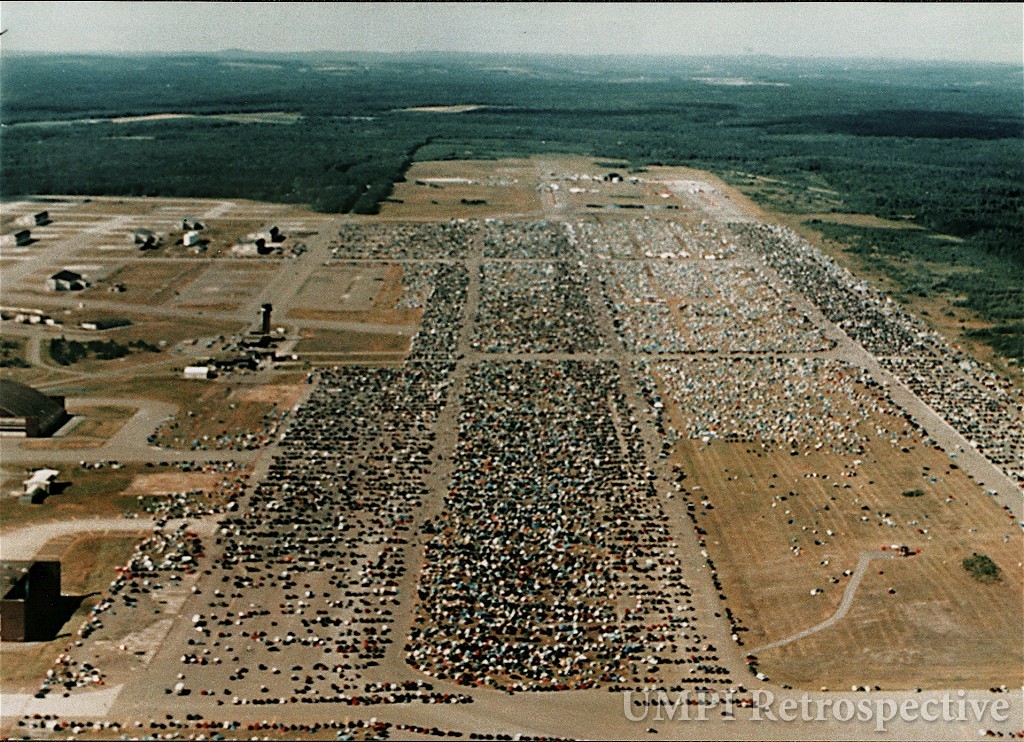
Phish put the weekend’s attendance at 65,000 to 70,000. From the stage, Trey Anastasio declared the temporary gathering Maine’s biggest city, bigger than Portland, and added that it was cooler than Portland, too.
I was there for the Great Went, and I came back when Phish returned the next summer.
Fans also built a tall art tower out of things they made over the weekend, and it was burned at the end of the festival.
Phish came back on August 15th and 16th, 1998, for Lemonwheel. The Maine Sunday Telegram put that crowd at more than 60,000.

This time the old bomber runway held a Ferris wheel, sculptures and, my favorite, a mechanical elephant that sprayed the crowd with water. Rain held up the Saturday show by 45 minutes.
A September 1998 survey photograph shows woven sapling sculptures at the gate of the old nuclear alert area, where B-52 crews once waited to take off. The catalog notes say a local artist added them that August, but do not identify them as Lemonwheel installations.

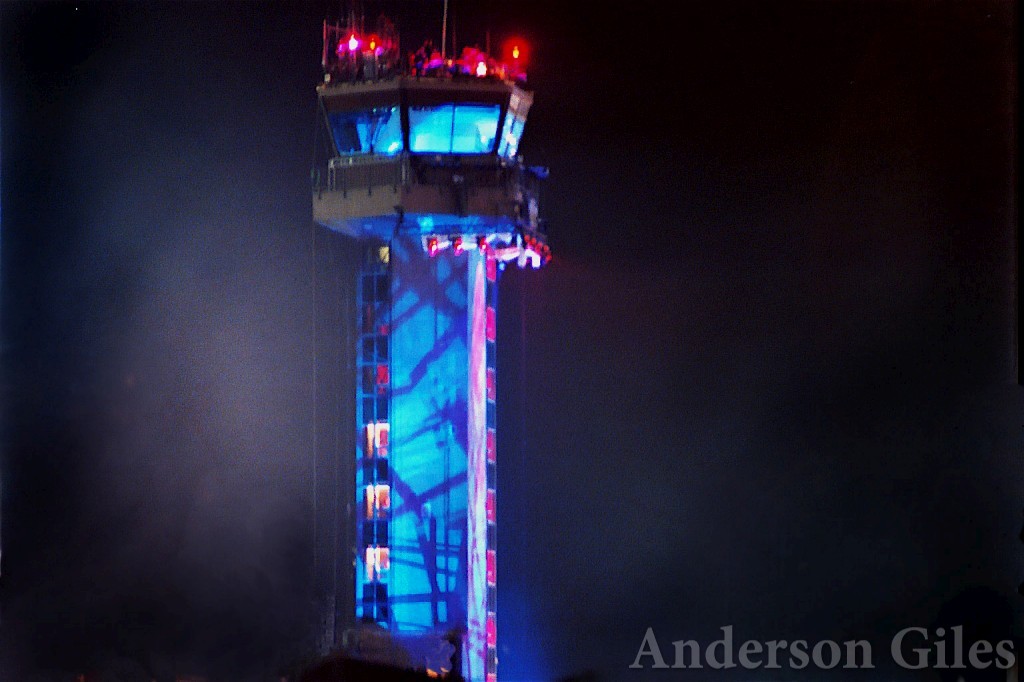
The band came back once more for It, on August 2nd and 3rd, 2003, and drew more than 60,000 people. Around 2 a.m. Sunday, Phish played a long jam from the top of the base’s old air traffic control tower. How cool is that?
For Aroostook before the bombers, look at Jack Delano’s color photographs of the 1940 potato harvest.
After the base closed
The state created the Loring Development Authority in 1993 to find new uses for the base, which became the Loring Commerce Centre.
In 1998, about 4,700 acres of the old base became the Aroostook National Wildlife Refuge. The former weapons storage area is part of the refuge.
In August 2022, a B-52 landed at Loring for the first time in 29 years.

Liked this one? Get more tomorrow.
Lost Maine stories in your inbox most mornings: the newest, plus a few from the archive.
 Noah Miller, the Lincolnville Man the British Wanted to Hang as a Pirate
Free. Unsubscribe anytime.
AI assisted editing and source review. Featured photograph cropped from an archival original, retained in the article. No images were generated or colorized with AI. Here’s how we use AI.Suggest a correction