

“OH BOY! WHAT JOY!” That’s how Riverton Park pitched itself in the Portland Sunday Telegram on May 27, 1923.
The whole page was headed “RIDE TO RIVERTON,” and the reopening ad promised a ballroom, the Dodgem, a merry-go-round and a Ferris wheel, opening on Memorial Day. There would be fireworks twice a week, free band concerts on Sundays and free outdoor vaudeville. Admission to the park was free.
Not bad for a park that had just come out of a detour into the movie business.
The comeback was real, and so was the ending. On January 23, 1933, the Portland Evening Express ran a staff photo of Riverton’s casino being razed.
A summer playground on the Presumpscot
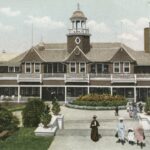
Riverton started as a streetcar company’s resort. The Portland Railroad established it as an amusement resort on the Presumpscot River. The 1909 Sanborn insurance map put it 4 miles northwest of Portland’s post office.
The man running it was Daniel Burleigh Smith. A 1919 biographical sketch of Smith says he became resident manager in 1896. The 1900 census found him on the job, listing Daniel B. Smith as manager of Riverton Park, with his wife, Elizabeth.
That sketch made the park sound pretty irresistible:
Casino, Rustic Theatre, canoe course, fishing pond and dancing floors furnish amusement for those whom the rural beauty of the park does not satisfy.
It even claimed the resort was so popular that the casino stayed open all winter.

The crowds were a real mix. Looking back in 1923, the Sunday Telegram remembered Portland residents, folks from the rural districts and summer visitors all crowding in. Country people drove down with their horse teams, or came into Portland and then rode out on the trolleys.
For a time the J. W. Gorman Amusement Company supplied the shows in the theater, from tabloid musical comedies to vaudeville. The same 1923 piece praises a blackface troupe as a sure crowd-pleaser, so racist entertainment was part of the bill at Riverton, too.
One of the stellar attractions it remembered was the Fadettes, an orchestra “composed wholly of women.” There were penny and nickel slot machines that played music, told your fortune or stamped a name plate, plus booths selling popcorn and soft drinks.
And there were animals. The 1923 writer remembered a collection of animals and birds in a hollow, and this scene by the water:
The youngsters liked nothing better than to watch the deer, and then they were fond of gazing at the fine trout leaping after flies and crumbs in the pool at the rustic bridge.
The same piece pictured kids in the theater seats, where they “tried to be comfortable with their little feet failing to touch the floor.” Back home, it said, “It was some distinction to be able to say that they had been to Riverton.”
What the 1909 Sanborn map shows
The best look at the park’s layout comes from that same fire insurance map. The 1909 Sanborn atlas of Portland gives Riverton its own detached inset on volume 2, sheet 8.
It labels the casino, a bicycle house, a boat house, a bandstand and a booth. Down at the Presumpscot, the boat house connects to a float on the river. Forest Avenue runs along one edge, a drive cuts through the grounds, and the Portland Rail Road Co. name sits in the middle of the park.
The casino was steam heated and electrically lit, with fire pails and chemical extinguishers on each floor. Another note says, “Family lives on premises.” The map doesn’t say who they were.

Then there’s the arrow. A note reads “300′ TO OPEN AIR THEATRE,” pointing past the casino toward a theater the map never draws.
A 1914 Richards atlas gives the wider view, with Riverton on the Presumpscot beside Prides Bridge, marked 18A, the atlas’s shorthand for 18 acres. It also draws an electric railway loop running into the park from the road by the bridge.

A movie studio in the woods
The crowds didn’t last. Looking back in 1925, The Billboard put it plainly: Riverton “before the era of the automobile enjoyed a splendid patronage. Latterly, however, patronage dropped off considerably and for several seasons the park was practically idle.”
By January 1922, the trade paper was calling it “this now abandoned property,” a resort that as recently as two years before had been “the summer playground of thousands of people.” The Charlton Film Company, which The Billboard called closely allied with the Keystone Company, had signed a lease to turn it into a movie studio.
The plan was to make films in “the casino buildings in the heavily wooded park,” and a $10,000 studio was announced.
A movie studio on the Presumpscot… in Maine. You have to admire the ambition.
In March 1923, The Billboard reported that the studio Charlton built had later been turned over to Riverton Films Inc. By then Riverton Films had given up its lease, and an amusement revival was in the works. Looking back in 1933, the Evening Express said the film venture didn’t pay off.
More elaborate than ever
The Billboard’s March 31, 1923 headline didn’t hold back: “Company To Invest $250,000 in Making Maine Resort More Elaborate Than Ever.” That company was the Riverton Realty Co., which the paper called the owners of the park.
The movie studio would become a dance hall with 60 by 120 feet of floor space, a new maple floor and 24-foot balconies. The casino would carry on as a restaurant, and the boathouse would have canoes “for rent by the day or month.”
Harry F. Blackwell, named general manager in the May reopening plans, lined up a roller coaster from the Philadelphia Toboggan Co. The Billboard said it would be similar to the coaster at Nantasket, “which is nearly a mile long.”
There would be a three-jumper carousel, a whip, a Ferris wheel and an ocean wave. A New York amusement company got the midway concessions, with games like the balloon racer and the “aeroplane flasher.” The aquarium and spring house would be repaired, with “spring water in abundance free of charge.”
Fenced off, and kicks registered
And that open-air theater on the Sanborn map? It didn’t make the cut. The Sunday Telegram explained on May 27, 1923:
No use is to be made of the old open-air theater, but this has been fenced off from the rest of the property, it being felt that there are sufficient other attractions without it.
Fair enough. They had a Ferris wheel coming.
The same report had plenty for families. Kids would get sand piles and slides, and the pool near the rustic bridge would be restocked with fish. An administration building near the bridge would take picnic bookings and answer questions, and anyone unhappy could “register their kicks, if they have any to make.”

Come by car, come by trolley
Riverton was chasing drivers hard. The plans set aside sixteen acres on the road leading to the park for free parking, plus a large gasoline station. The Billboard said it would “offer accommodations not only to motorists who are visiting the park, but also to tourists on their way to the White Mountains.”
The Sunday Telegram promised gasoline, water and air right there. That way, “the man with a buzz wagon who visits Riverton need not worry if he finds he has busted a tire or is short of oil or gas.”
The reopening ad advertised parking for 2,000 automobiles. But it also promised “Extra Street Car Service.”
The trolleys would again “make the complete loop thru the park as they used to do in the heyday of Riverton’s popularity.” Riverton Realty met with the trolley company, the Cumberland County Power & Light Co., about a lower fare, and a 10-cent fare was expected.
That company’s railway department made its own pitch in the same section:
It is reliable, means less trouble, less auto congestion, relieves you of all worry, safe and convenient, and lands you inside the Park.
Even the ice cream got an ad: S. & H. was supposedly the only kind sold at Riverton Park.
The banner across the top of the page gave the game away. The whole section was paid advertising: “THE ADVERTISERS IN THIS SECTION BUILT RIVERTON.”

The revival really did happen. In January 1925, The Billboard reported that the Riverton Amusement Company had operated the park in 1923 with only about half the rides it had later, and expanded in 1924.
The trade paper heard that 1924 was a good season, and it listed the whip, dodgem, roller coaster, airplane swings, Shetland ponies and a roller skating rink. There were vaudeville acts and dare-devil stunts, too.
It didn’t stick. As the Evening Express put it in 1933, “again the park suffered a relapse, this time a fatal one.”
The casino comes down
Here’s how the Evening Express opened its front-page story on January 23, 1933:
ITS FAME as the pleasure resort of Maine long since gone, now the last vestiges of Riverton Park, once a fully equipped and heavily patronized amusement resort, are passing.
Workmen were demolishing what remained, and the job would go on until “the last upright has been removed.” The paper remembered Riverton as a place for family outings, club reunions and dinners. The outdoor theater, it said, “was filled to overflowing each week-day afternoon and evening.”
The Evening Express blamed the automobile, which put beaches, lakes, mountains and distant resorts within reach. Riverton’s “structures, unused, faced the first stages of ruin.” The car that could bring you to Riverton could also take you somewhere else.
The paper reported that the Casco Mercantile Trust Company now controlled the premises through a subsidiary realty corporation. An unnamed company official said the demolition would remove “worthless property.”

The front-page caption remembered the casino’s better days:
The once proud Riverton Casino, where the biggest and best events in this section were held 30 odd years ago, is the last of the older structures of old Riverton Park to be demolished.
In the photograph, it still has its roof and much of its porch, with debris scattered across the ground.
Liked this one? Get more tomorrow.
Lost Maine stories in your inbox most mornings: the newest, plus a few from the archive.
 This storyRiverton Park’s Comeback, Before the Casino Came Down
 The Night Portland Went Dark
 The 1918 Crash That Gave Lincolnville a Bridge on Top of a Bridge
Free. Unsubscribe anytime.
AI helped research and write this story. Here’s how we use AI.Suggest a correction