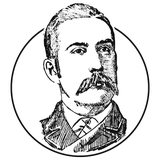


On February 23rd, 1936, a harness horse named Brother Q lost two straight heats on the ice of Hosmer Pond in Camden.
His owner was a Camden dairyman named Harold Nash. By that fall, the town had bought 45 acres from him, and volunteers were turning the land into the Camden Snow Bowl.
It’s a great Maine origin story. In the middle of the Great Depression, a town built its own ski area … mostly on Sundays.
Hosmer’s Pond before the Snow Bowl
Long before anyone skied here, the pond had neighbors. On the 1875 map of Camden it carries a family name, Hosmer’s Pond, and a house marked “Hosmer” sits on the road above its north end.

Ragged Mountain rises right behind the pond, and a road ran along the east shore toward town, past a scattering of houses.
The U.S. Geological Survey’s 1906 map shows the same picture, with Hosmer Pond at the foot of Ragged Mountain about three miles west of Camden village. Just over the hill to the east is Melvin Heights, where Harold Nash would make his home.

The carnival on Hosmer Pond
Camden held its first winter carnival at Hosmer Pond in late February 1936, and it ran over a weekend and into Monday.
Check out this aerial photo from that winter. Cars are parked in rows on the ice, with a hockey rink plowed out in the middle and tracks circling it for the ski races and horse races.

On the big Sunday, 3,500 people turned out, the Portland Press Herald reported.
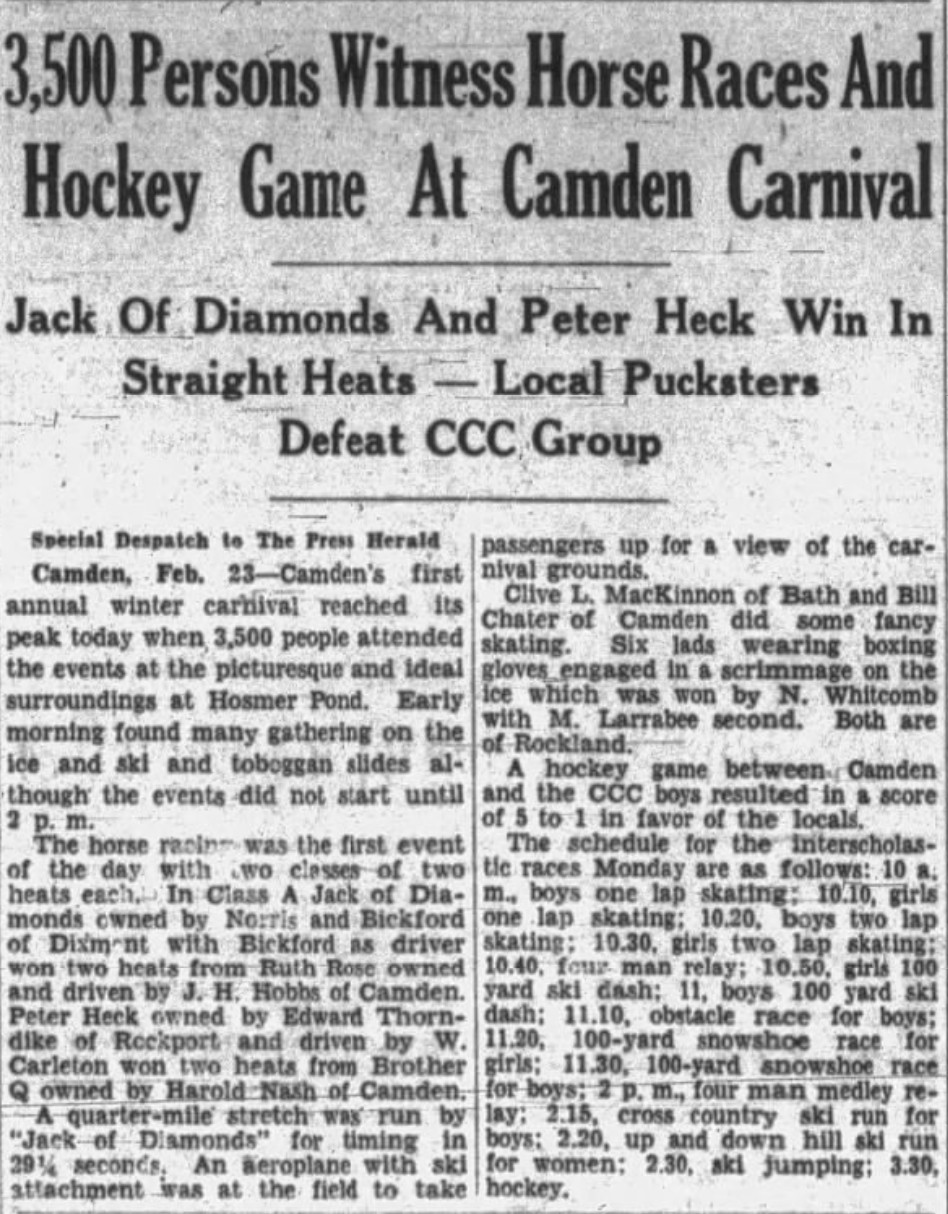
The horses raced in heats on the ice, and Peter Heck, owned by Edward Thorndike of Rockport, beat Nash’s Brother Q twice (sorry, Brother Q).
Camden’s hockey team beat a crew from the Civilian Conservation Corps camp 5 to 1, and six boys in boxing gloves staged a free-for-all on the ice. There was even a plane on skis taking passengers up for a look at the whole scene from above. How fun is that?
Who was Harold H. Nash?
Harold H. Nash was a farmer, and a well-known one.
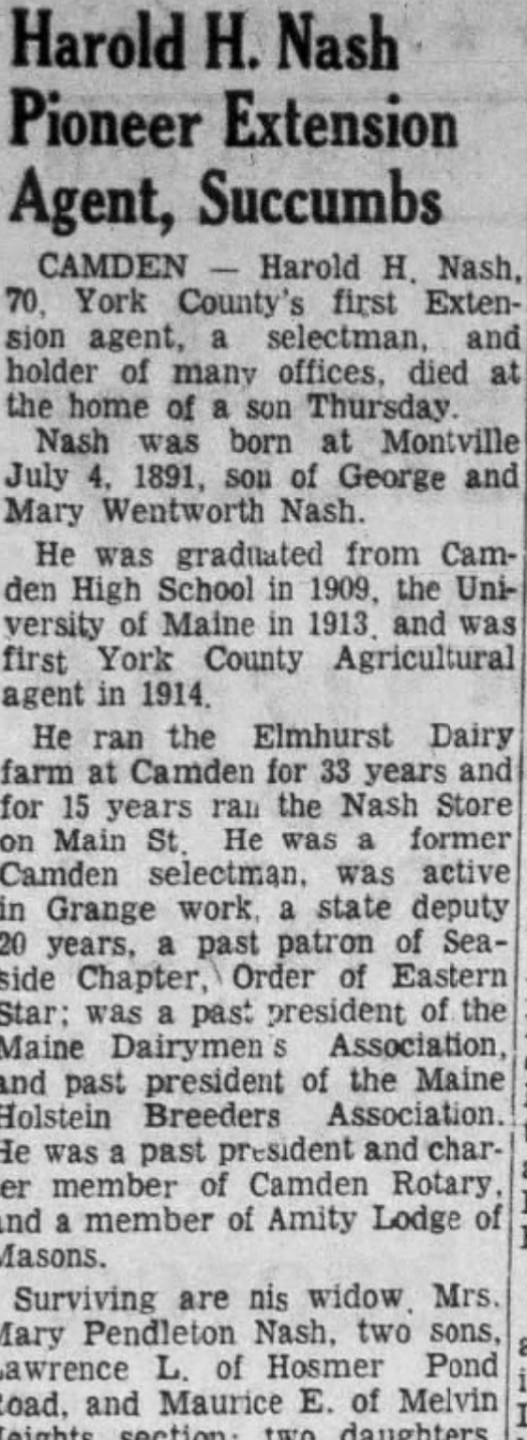
Back home in Camden, he ran the Elmhurst Dairy farm for 33 years, and for 15 of them he also ran the Nash Store on Main Street.
Camden buys 45 acres
The carnival was such a hit that Camden decided to make it permanent. That fall the Portland Sunday Telegram reported that the town had recently bought about 45 acres from Nash for a winter sports area.

The Camden Outing Club drew up the plan, and it was ambitious. It put toboggan slides and a ski jump on the slope, a downhill trail and another trail climbing toward Ragged Mountain, and horse racing and ice boating out on the pond.
The Telegram said the ski trails would run from one to five miles, and there would be a hockey rink too. The whole project would cost about $10,000, with $3,000 needed to get started.
Eugene C. Rich was the club’s president, and the project had friends in Augusta. The Maine Development Commission backed it, and Governor-elect Lewis O. Barrows came out to look it over.
Built by volunteers on Sundays
Camden leaned on volunteers. The Telegram described who was doing the work:
Local carpenters, masons, surveyors and laborers are giving their time each Sunday.
You have to love that. The centerpiece was a lodge, 25 by 80 feet, with a big main room, two wings and two large fireplaces. The club’s secretary, Francis Merchant, drew the design himself.

There was no road to the site yet, so the volunteers rafted the lumber across Hosmer Pond (yes, across the pond), according to the Camden-Rockport Historical Society. Construction started in September 1936, and the lodge was finished in January 1937, the society says.

1937: the papers call it the Snow Bowl
By the next winter, the papers were calling it the Snow Bowl. The second carnival ran over three days in February 1937, this time sponsored by the Outing Club.
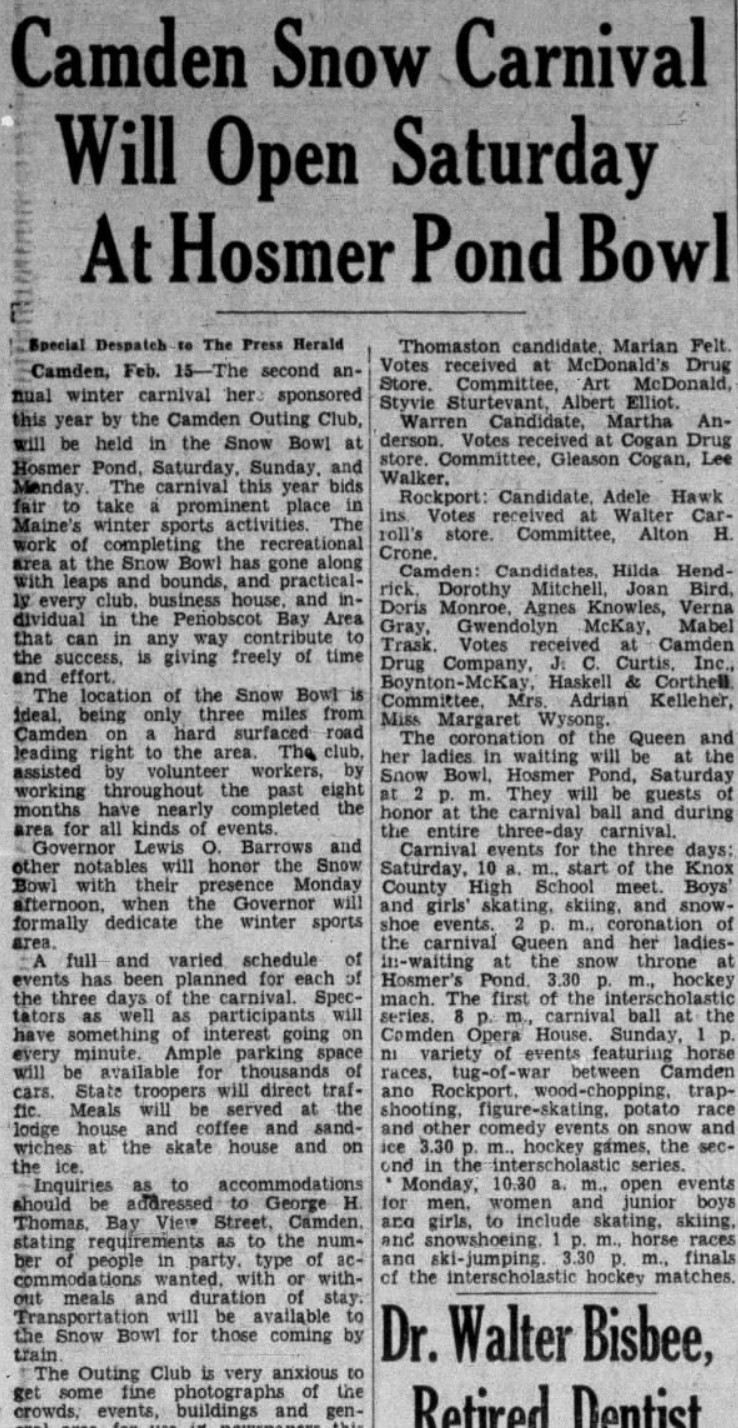
The Press Herald said volunteers had spent eight months getting the area ready, and it made a point of the location, just three miles from Camden on a paved road.
The Sunday Telegram ran a whole spread of photos from the carnival.

Snow was scarce across most of Maine that year, but not at Camden. The paper ran a photo of four young women from town on a toboggan to prove it.
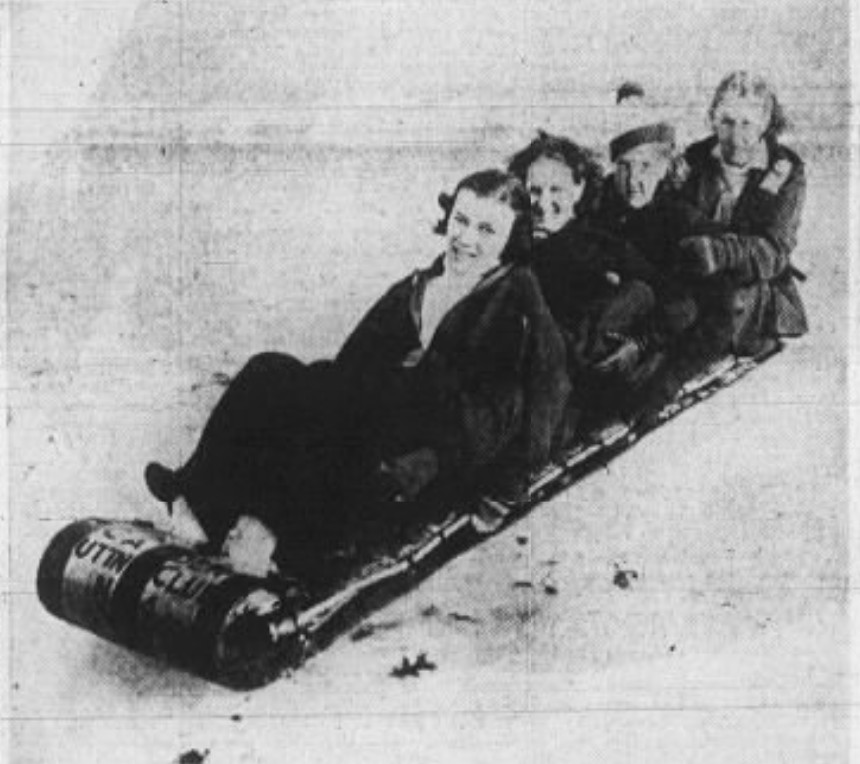
The horses came back too, from six towns and cities, and more than 3,000 people watched them race on the pond that Sunday.

The dedication that got rained out
The big moment was set for Monday, February 22nd, 1937. Governor Barrows was going to dedicate the Snow Bowl at 3 p.m. The Press Herald billed it as the only permanent winter sports arena of its kind in New England.
It rained … of course. The Associated Press reported that the closing day of the carnival was washed out, and the Governor’s dedication with it.
1938: the Governor finally visits
Barrows made it out a year later. On Sunday, February 20th, 1938, nearly 10,000 people came to the Snow Bowl for his official visit, the Press Herald reported.

Barrows greeted the crowd, watched the hockey game and toured Camden with carnival queen Mary Bryant.
The paper called it an official visit, though, and whether Barrows ever formally dedicated the Snow Bowl isn’t clear.

The Snow Bowl after 1938
The Outing Club ran the Snow Bowl for decades. A rope tow carried skiers through the early years, and a T-bar finally arrived in January 1967, according to NewEnglandSkiHistory.com.
That November the old volunteer-built lodge burned, in a fire that started near a gas hot water heater, according to the Camden-Rockport Historical Society. A new A-frame lodge went up in 1968.
A double chairlift came in 1975. The club stopped running the area after the 1980-81 season, and Samoset Resort ran it for three winters before handing it back to the town, NewEnglandSkiHistory.com reports.
Toboggans were part of the plan from the start, and Camden’s chute has been rebuilt more than once. According to Yankee Magazine, the original didn’t last long, the U.S. Coast Guard rebuilt it in 1954, and it had decayed again by 1964.
Jack R. Williams led another rebuild starting in 1990, and the chute that carries his name was dedicated in January 1991.
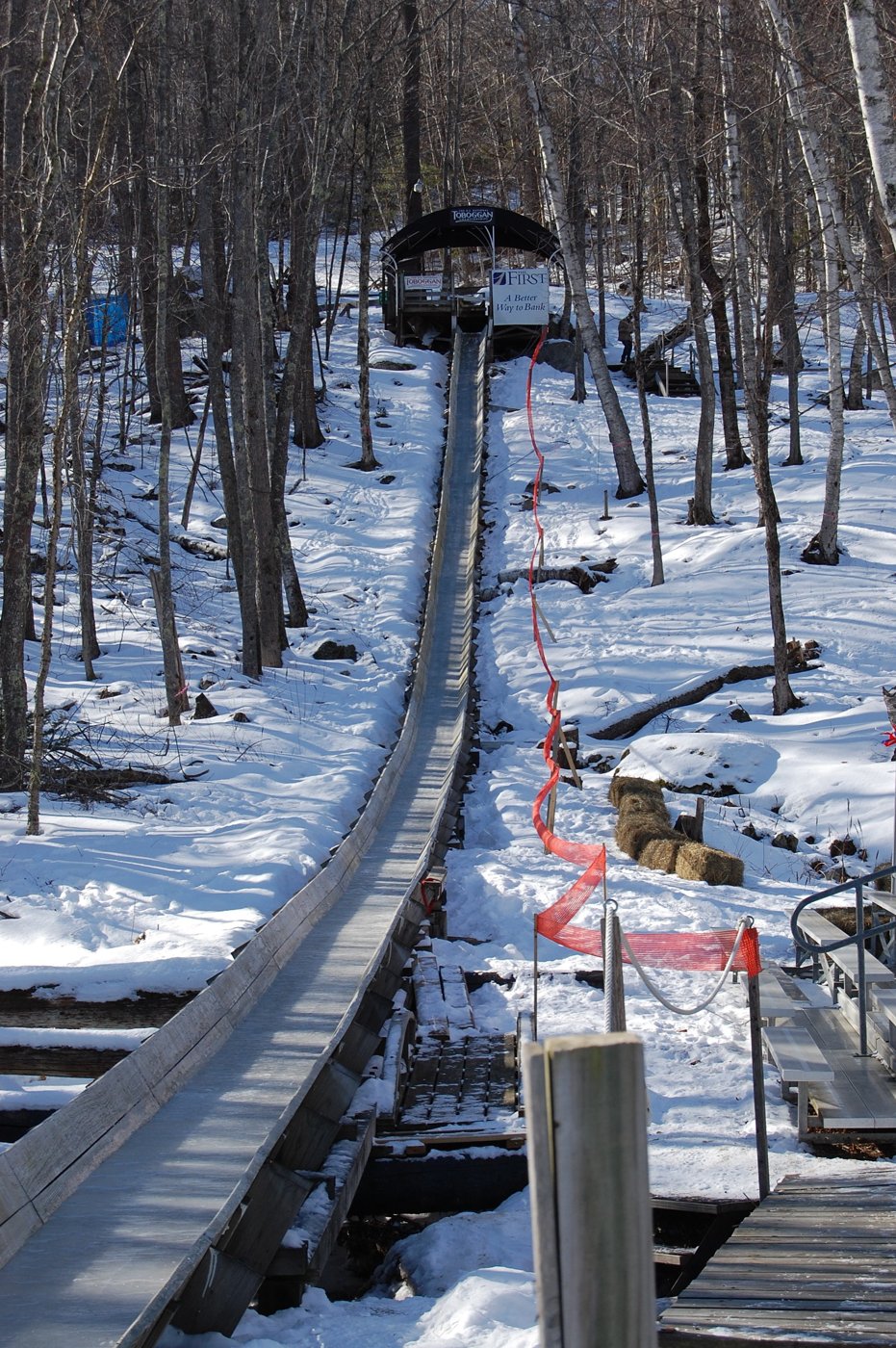
Yankee dates the first U.S. National Toboggan Championships to February 24th, 1991. The chute runs about 440 feet and sends riders out onto snow-covered Hosmer Pond.
Today the town of Camden still owns the Snow Bowl, town staff run it, and it lists 1,000 vertical feet on Ragged Mountain.
Liked this one? Get more tomorrow.
Lost Maine stories in your inbox most mornings: the newest, plus a few from the archive.
 Loring Air Force Base: The Maine Base That Hid Atomic Bombs, Then Hosted Phish
 Noah Miller, the Lincolnville Man the British Wanted to Hang as a Pirate
Free. Unsubscribe anytime.
AI helped research and write this story. Here’s how we use AI.Suggest a correction